
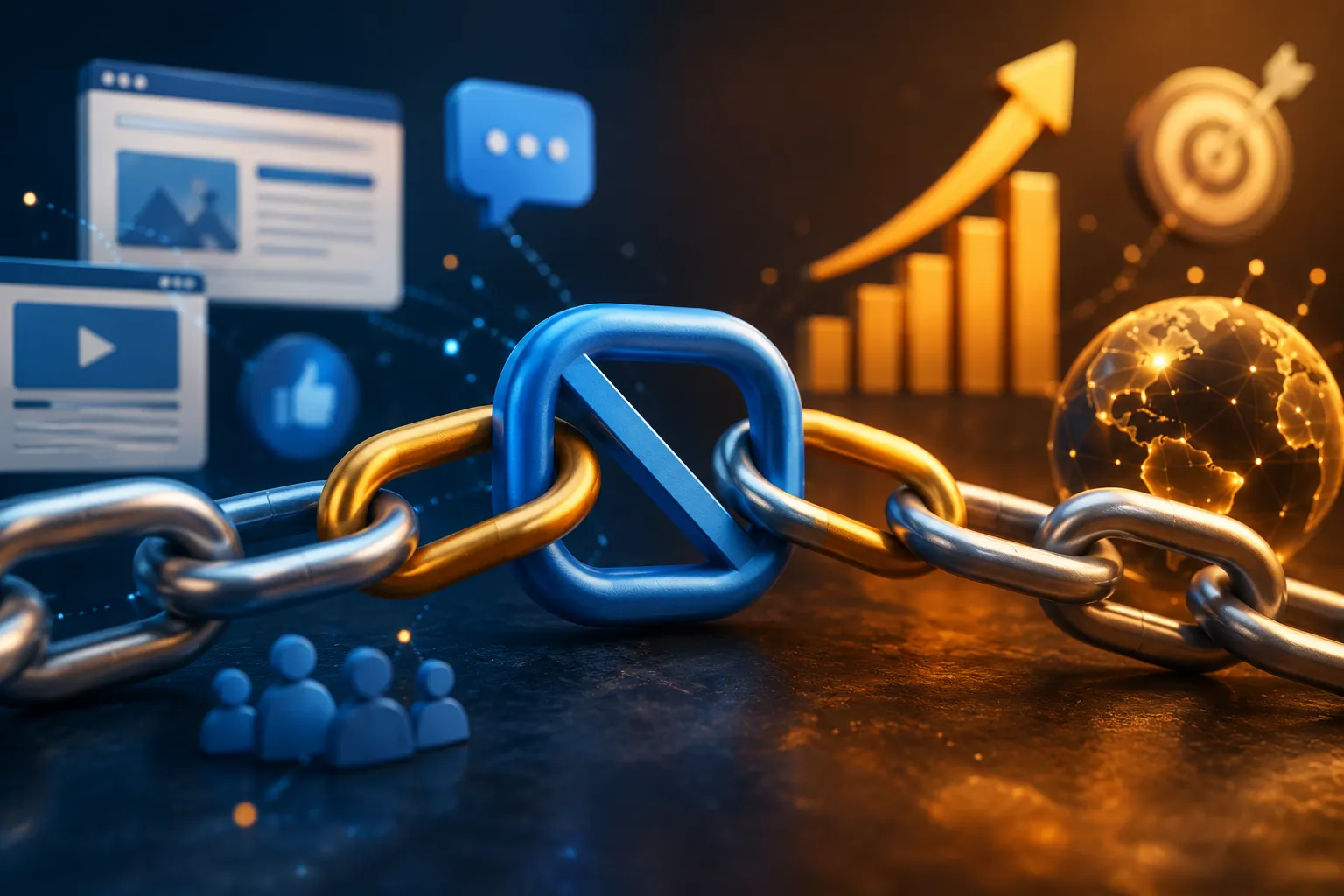
Do Nofollow Links Help SEO? What They Actually Do in 2026
If you have been building backlinks for SEO, you have probably heard the same advice again and again: nofollow links do not help rankings.
That answer is too simple for SEO in 2026.
Nofollow links are not the same as traditional followed backlinks, and you should not expect a nofollow backlink to pass the same ranking signals as a normal editorial link. However, that does not mean nofollow links are useless. They can still bring referral traffic, expose your brand to new audiences, support discovery, create relationships, generate future followed links, and contribute to a natural-looking backlink profile.
There is also an important distinction that often gets missed. A nofollow link pointing to your website is different from a nofollow link that you place on your own website.
Google treats rel="nofollow" as a way of qualifying links when you do not want to associate your site with the destination or when you would rather Google not crawl the linked page from your site. Google also recommends rel="sponsored" for paid links and rel="ugc" for user-generated links.
So, do nofollow links help SEO?
Yes, but usually not in the direct “this link passes ranking authority” way people imagine.
The real value depends on where the link comes from, why it exists, whether people actually click it, how relevant the referring website is, and what happens after someone discovers your website.
What Is a Nofollow Link?
A nofollow link is a hyperlink containing the rel="nofollow" attribute.
It looks like this:
<a href="https://example.com" rel="nofollow">Example</a>The attribute tells search engines that you do not want to treat the link as a regular editorial endorsement.
Google’s current documentation says to use nofollow when other qualifying values do not apply and you would rather Google not associate your site with the linked page or crawl the linked page from your site. Google also notes that pages connected through these links can still be discovered through other means, such as XML sitemaps or other links.
That last point matters.
Nofollow does not mean invisible.
It does not automatically mean:
- Google will never discover the URL
- nobody can click the link
- the link has zero SEO value
- the referring website is worthless
- your website cannot benefit from the exposure
It simply means you should not treat that link as an ordinary followed editorial link.
Do Nofollow Backlinks Pass Link Authority?
This is where the answer needs to be precise.
A normal editorial backlink can function as a ranking signal because links help search engines understand relationships, relevance, and authority across the web.
A nofollow backlink should not be acquired with the expectation that it will pass the same ranking credit as a followed backlink.
Google’s documentation specifically recommends using nofollow when you do not want to associate your site with the destination. Its SEO documentation also says not to use nofollow for every external link. Instead, use it when there is a reason to qualify the relationship.
That means you should not think:
“I got 100 nofollow backlinks, so Google will give me the equivalent authority of 100 followed backlinks.”
That is not a safe SEO strategy.
A better way to think about nofollow links is:
They can create SEO opportunities without necessarily functioning as direct link equity.
That difference is extremely important.
Nofollow Links Can Still Send Referral Traffic
The most obvious benefit is also the most overlooked.
A nofollow link can send real visitors to your website.
Imagine you publish a detailed article about CRM implementation. A respected industry website mentions your research and links to it with rel="nofollow".
If 500 relevant readers click that link and visit your article, you have gained something valuable even if you never receive traditional ranking credit from that backlink.
Those visitors can:
- read your content
- visit other pages
- subscribe to your email list
- contact your business
- share your article
- mention your brand elsewhere
- link to your content from their own websites
The SEO benefit may therefore happen indirectly.
This is one reason it is dangerous to judge every backlink solely by whether it is followed or nofollowed.
Nofollow Links Can Help People Discover Your Brand
SEO is no longer only about collecting links.
Search has increasingly become an ecosystem involving traditional search results, AI-generated answers, social platforms, communities, video platforms, newsletters, and other discovery channels.
Bing’s current webmaster guidance explicitly discusses visibility across traditional search, Copilot, and AI-powered experiences. It says clear content, strong discovery signals, authority, and trustworthy information support visibility across these systems.
A nofollow link can put your brand in front of people who had never heard of you.
For example, suppose a popular industry publication links to your website with a nofollow attribute.
Someone reads the article.
They remember your brand.
Later, they search your company name.
Or they search for a service you provide.
Or they mention your brand in another article.
Or they decide to link to one of your resources.
The original nofollow link may not have been a conventional authority-passing backlink, but it helped create the visibility and discovery that produced additional signals later.
That is a very different type of SEO value.
Nofollow Links Can Lead to Followed Links
This is probably one of their biggest practical benefits.
Think of link building as a network rather than a spreadsheet.
You publish an excellent resource.
A website links to it with nofollow.
A journalist sees the resource.
A different blogger discovers it through that article.
The blogger references your research and gives you a normal editorial backlink.
Now you have a followed backlink.
The original nofollow link did not necessarily pass traditional ranking credit directly. But it helped put your content in front of the person who eventually created the followed link.
This is why link acquisition should not be reduced to dofollow versus nofollow.
The better question is:
Did this link put my website in front of the right people?
If the answer is yes, the link may have real marketing and SEO value.
Are Nofollow Links Good for a Natural Backlink Profile?
A healthy website will rarely acquire backlinks from only one type of source.
Real websites get mentioned in:
- forums
- social communities
- news articles
- directories
- blogs
- podcasts
- industry publications
- review websites
- user-generated platforms
- resource pages
- interviews
- professional communities
Those links can have different attributes and different levels of SEO value.
That is normal.
The goal should not be to manufacture a perfectly controlled backlink profile containing a specific percentage of followed and nofollow links.
Google’s spam policies focus heavily on manipulative link acquisition, including buying links for ranking purposes, excessive link exchanges, automated link creation, and other schemes intended to manipulate rankings.
In other words, obsessing over link attributes can distract you from the bigger issue:
Was the link earned naturally, and does it make sense?
Nofollow Links From High-Authority Websites Are Still Valuable
Here is another common misconception.
Someone might say:
“That website has a huge authority score, but the backlink is nofollow, so it is useless.”
That is not how I would evaluate it.
Suppose a major publication in your industry mentions your website and sends you a nofollow link.
Even if you receive little or no traditional ranking credit from the link itself, the exposure can still be significant.
You may receive:
- referral visitors
- brand awareness
- leads
- customers
- journalist attention
- networking opportunities
- future mentions
- future backlinks
- credibility with potential customers
The traffic and business value could be much greater than that of a random followed link from an irrelevant website.
This is why relevance and audience quality can matter more to your overall strategy than the follow attribute alone.
What About Nofollow Links From Social Media?
Social platforms are a good example of why the “nofollow equals useless” idea breaks down.
Links from social platforms may not function like traditional editorial backlinks that pass ranking credit.
But social platforms can still create discovery.
Someone sees your article.
They visit your website.
They share it.
Another person discovers it.
A journalist finds your research.
A publisher references it.
Someone eventually gives you an editorial backlink.
The original social link may have been nofollow or otherwise qualified, but it still participated in the discovery process.
You should therefore treat social links primarily as distribution and visibility channels, rather than trying to use them as substitutes for high-quality editorial backlinks.
Nofollow Links and Google Discoverability
There is another subtle point.
Google says qualified links such as nofollow links will generally not be followed, but the linked page may still be discovered through other methods.
That means you should never use nofollow links as your primary technical discovery system.
If you have an important page, make sure Google can discover it through your own site’s architecture.
For example:
- use crawlable internal links
- include important URLs in your XML sitemap
- avoid orphan pages
- maintain a logical site structure
- use descriptive anchor text
- make important content accessible through normal navigation
A nofollow backlink should be considered an additional discovery opportunity, not a replacement for proper technical SEO.
Do Nofollow Links Help AI Search and GEO?
This area needs more caution because the search ecosystem is changing quickly.
In 2026, Google and Bing are increasingly presenting information through AI-powered search experiences.
Bing’s Webmaster Guidelines now explicitly connect SEO fundamentals with eligibility for AI-powered experiences and grounding. Bing says external links from relevant websites can support discovery, while clear structure, content quality, authority, and verifiability support visibility in search and AI experiences.
Bing also launched an AI Performance report in 2026 that allows publishers to see how their pages appear as citations in Microsoft Copilot, AI-generated Bing answers, and related experiences.
However, there is not enough evidence to claim that a nofollow backlink itself is a direct GEO ranking factor.
That distinction matters.
You should not publish an article saying:
“Nofollow backlinks make ChatGPT cite your website.”
There is no solid basis for that claim.
Instead, think about the broader chain:
Quality content → discovery → mentions and references → stronger visibility → potential citations and traffic.
The quality, clarity, originality, relevance, and verifiability of your content remain much more important than trying to manipulate link attributes.
Nofollow vs Sponsored vs UGC
These three attributes are often mixed together, but they have different purposes.
rel="nofollow"
Use this when you want to tell Google not to associate your site with the destination or you would rather Google not crawl the linked page from your site.
rel="sponsored"
Use this for advertisements, paid placements, and other sponsored relationships.
Google currently prefers sponsored for paid links, although nofollow remains acceptable.
rel="ugc"
UGC means user-generated content.
This is appropriate for links added by users, such as links in:
- forum posts
- comments
- community discussions
- Q&A platforms
Google recommends ugc for these types of links.
You can also combine attributes when appropriate, such as:
rel="ugc nofollow"The important thing is not to choose an attribute because you think it will “trick” Google into giving you more authority.
Use the attribute that accurately describes the relationship.
Should You Build Nofollow Backlinks on Purpose?
Yes, but with an important qualification.
Do not build nofollow links simply to increase your backlink count.
Build links because the website, audience, placement, or exposure is valuable.
For example, a nofollow link can be worth pursuing if it comes from:
- a respected industry publication
- a relevant community
- a popular resource
- a podcast website
- a news publication
- a professional organization
- a strong niche website
- a platform where your target audience actually spends time
On the other hand, there is little reason to spend hours obtaining hundreds of nofollow links from unrelated websites nobody visits.
That is just backlink collecting.
And backlink collecting is not the same thing as SEO.
Are 100 Nofollow Links Better Than One Followed Link?
There is no universal mathematical answer.
One highly relevant editorial backlink from a respected website can be more valuable for SEO than hundreds of weak links.
Likewise, one nofollow mention from a major publication could generate more business than dozens of followed links from obscure websites.
So don’t evaluate links only by quantity.
Look at:
Relevance + credibility + audience + placement + traffic potential + editorial context + relationship
A link from a website your customers already trust can be extremely valuable even when it is nofollow.
What Nofollow Links Should You Avoid?
Not every nofollow link is automatically good.
A nofollow link can still be a waste of time if it comes from:
- obvious spam websites
- irrelevant directories
- automated link networks
- scraped websites
- pages created solely to distribute links
- sites with no real audience
- unrelated blog comments
- low-quality forum profiles
- pages stuffed with hundreds of outbound links
The nofollow attribute does not magically transform a bad website into a valuable SEO asset.
Google’s spam policies specifically warn against automated link creation, manipulative link exchanges, paid links intended to manipulate rankings, and other forms of link spam.
The Biggest Mistake: Chasing Link Attributes
If you are building backlinks for a relatively new website, it is tempting to create a spreadsheet like this:
| Website | DR | DA | Follow | Nofollow | Anchor |
|---|---|---|---|---|---|
| Site A | 70 | 65 | Yes | No | SEO |
| Site B | 80 | 75 | No | Yes | Brand |
| Site C | 60 | 58 | Yes | No | Website |
This can be useful for organizing outreach, but it should not become your entire strategy.
Third-party metrics such as Domain Authority and Domain Rating are not Google ranking factors.
A website with a high third-party score can still have little real audience, weak topical relevance, or poor editorial standards.
Instead, ask:
Would I want this website to mention my business even if Google did not exist?
If the answer is yes, you may have found a worthwhile link opportunity.
A Practical 2026 Backlink Strategy
For most websites, I would prioritize backlinks roughly like this:
1. Relevant editorial backlinks
These should remain the priority.
Earn them through genuinely useful resources, original research, expert contributions, digital PR, data, studies, tools, and content that publishers actually want to reference.
2. Industry and niche mentions
Get your brand in front of people who already care about your subject.
These can be followed or nofollowed.
The audience matters.
3. Strategic nofollow opportunities
Do not reject a valuable publication or community simply because the link is nofollow.
If the audience is relevant and the placement is legitimate, it can still be worthwhile.
4. Brand mentions
Even when a mention does not produce a traditional followed backlink, it can increase awareness and create opportunities for future coverage.
5. Social and community distribution
Use these channels to get your best content discovered rather than treating them as a backlink-number game.
The Bottom Line
So, do nofollow links help SEO in 2026?
Yes, but not in the simplistic way many backlink sellers claim.
A nofollow backlink generally should not be treated as equivalent to a normal followed editorial backlink for passing ranking credit. Google specifically provides nofollow, sponsored, and ugc attributes so website owners can accurately qualify different kinds of links.
But nofollow links can still have substantial indirect value.
They can:
- send referral traffic
- increase brand visibility
- introduce your content to new audiences
- create relationships with publishers
- generate future followed backlinks
- support content discovery
- expose your expertise to journalists and creators
- contribute to a natural web presence
- create business opportunities
The smartest SEO strategy in 2026 is therefore not:
“Get as many followed backlinks as possible.”
It is:
“Become worth mentioning in places where relevant people already pay attention.”
If the resulting link is followed, great.
If it is nofollowed, that does not automatically make the opportunity worthless.
And if you are choosing between a random followed backlink from an irrelevant website and a nofollow mention from a genuinely relevant publication with a real audience, I would take the second opportunity much more seriously.
Because ultimately, SEO is not a game where every link has a fixed numerical value.
The best links are the ones that connect your website to the right people, the right topics, and the right sources of trust.


2 Comments