
Do Rich Snippets Help SEO? Here’s What Actually Works in 2026
Rich snippets do not directly boost your rankings. Google has said this for years, and nothing in 2026 has changed it. But they change how people behave once they see your listing. More clicks, better qualified traffic, and stronger signals to Google about what your page is actually about. And in 2026, there is a second layer to this story that most guides skip entirely, which is how structured data feeds AI Overviews and other AI search tools that now sit above the regular results.
This article breaks down what rich snippets really do, what changed recently, and how to use them the right way without wasting your time on markup that no longer works.
What Rich Snippets Actually Are
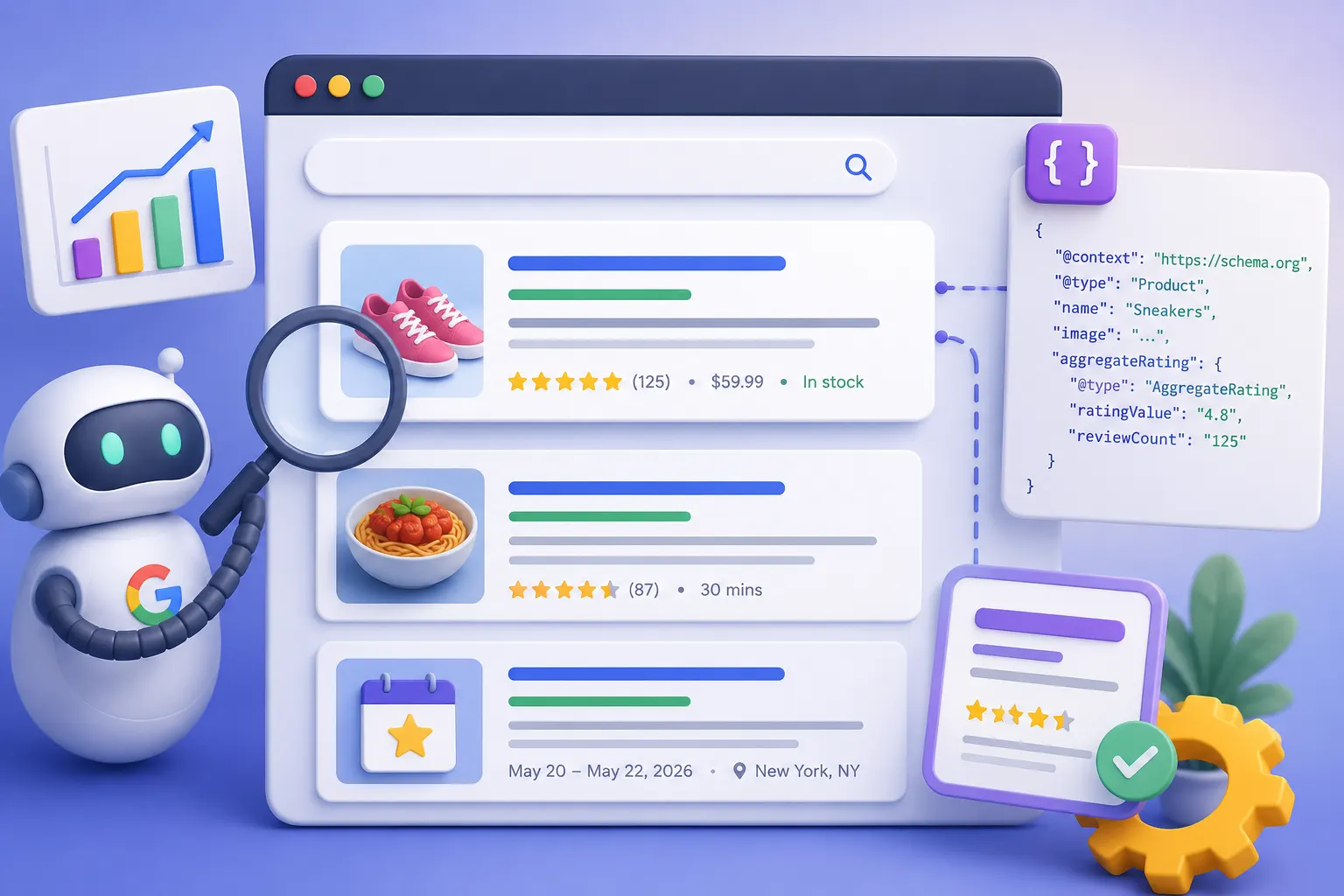
A rich snippet is an enhanced search result. Instead of just a blue link, a title, and a short description, the listing shows extra details pulled directly from structured data on your page. That structured data usually lives in a format called schema markup, written in JSON-LD, which sits quietly in your page code and tells search engines exactly what kind of content they are looking at.
Common examples include:
- Star ratings and review counts on product or service pages
- Prices and stock availability for online stores
- Cooking time and ingredients for recipes
- Event dates and locations
- Business hours and address for local listings
- Video thumbnails and duration
None of this is guesswork on Google’s part. You are handing Google the exact facts in a language it can read instantly, instead of making it guess from your paragraph text.
Do Rich Snippets They Help SEO or Not
Rich snippets do not push your page from position 8 to position 2. Google’s own documentation has repeated this for years, and nothing about that has shifted in 2026. Structured data is not a ranking factor.
What rich snippets do change is click-through rate, and click-through rate matters a lot in practice. Picture two results sitting next to each other on the same search page. One is a plain blue link with a short description. The other shows a 4.8 star rating, a price, and three hundred reviews. Most people click the one that looks trustworthy and informative before they even read the title properly. That is the actual power of a rich snippet. It does not change your position, it changes what your position is worth.
Multiple studies from 2026 back this up. Pages using proper structured data see click-through rate gains that commonly range between 15 and 30 percent compared to plain listings, and one large study tracking over a million search queries found rich results appearing in close to a third of ecommerce searches, with price and rating info being the most common addition people react to.
One agency case study this year reported a 29 percent jump in organic revenue after adding review, product, and breadcrumb schema, without the site’s average ranking position moving at all. The traffic did not change because rankings improved. It changed because more people trusted the listing enough to click, and more of those people converted once they landed.
So the short version is this. Rich snippets will not carry a weak page to the top. But on a page that already deserves to rank, they make sure more of the people who see it actually visit it.
The Big 2026 Shift Nobody Talks About Enough
This is the part that makes 2026 genuinely different from a couple of years ago, and it is the reason so much older advice about rich snippets is now outdated.
Google has been quietly shrinking the list of schema types that actually produce a visible rich result. HowTo rich results were pulled from mobile search back in 2023 and removed completely about a month later. FAQ rich results held on longer, but Google finally pulled them for everyone in May 2026, and the FAQ report inside Search Console disappeared along with them. If you are still adding FAQ schema hoping for that expandable question box in search results, it will not show up anymore. The markup itself is not harmful to keep, but do not expect a visual reward from it.
What still reliably produces rich results in 2026:
- Product schema, showing price, availability, and review stars
- Review and AggregateRating schema
- LocalBusiness schema for contact and location pages
- Event schema for dates and ticket info
- Recipe schema for cooking content
- Video schema for thumbnails and duration
The pattern is clear once you see it. Google is keeping the schema types tied to commerce, local search, and media, and retiring the ones people were gaming with generic content, like stuffing FAQ boxes into blog posts that had nothing to do with actual customer questions.
Why Structured Data Still Matters Even Without the Visual Reward
Here is where it gets genuinely important for anyone writing content in 2026, not just ecommerce owners. Even schema types that no longer produce a visible search result still feed something else entirely: AI Overviews and generative search answers.
When Google builds an AI generated summary at the top of a search page, it often pulls the classic rich snippet or featured snippet display right off the page, replacing it with its own generated text. That might sound like structured data lost its purpose.
It is actually the opposite. Google’s AI systems lean on well organized, clearly labeled content when deciding what to cite and summarize. A page with clean schema, clear headings, and a logical structure is easier for an AI system to parse and trust than a wall of unstructured text saying the same thing.
This is the idea behind AEO, answer engine optimization, and GEO, generative engine optimization. Both terms describe the same shift. You are no longer just writing for a person scanning ten blue links.
You are writing for a system that reads your page, extracts entities and facts from it, and decides whether to quote you inside an AI generated answer. Structured data is the clearest signal you can give that system about what your page contains.
So the practical takeaway is this. Keep using schema even on pages where the visible reward disappeared. A well marked up FAQ section can still be the exact block of text an AI Overview pulls from, even without the blue expandable box in classic search.
Rich Snippets vs Featured Snippets: A Common Mix-Up
A lot of site owners use these two terms as if they mean the same thing, and it causes confusion. They are related but they work differently.
A rich snippet is the visual add-on, like stars or a price, and it comes purely from structured data you add to the page. A featured snippet is the short answer box that sometimes appears above the first organic result, pulled from your actual written content, not your schema code. Google chooses a featured snippet because your paragraph or list answers a question clearly and concisely, not because you marked it up in JSON-LD.
A single page can actually earn both at once. Think of a recipe page. It might show a star rating and cook time as a rich result, while a separate part of the same page gets pulled into a featured snippet box for a question like “how long to bake a sourdough loaf.” One comes from structured data. The other comes from how clearly you wrote the content itself. You need both pieces working together, not one instead of the other.
E-E-A-T and Why Entities Matter More Than Keywords Now
Search in 2026 has moved past simple keyword matching. Google’s systems increasingly think in terms of entities, meaning real world people, places, organizations, and concepts, and how they connect to each other. This ties directly into E-E-A-T, which stands for experience, expertise, authoritativeness, and trust.
One practical way schema supports this is through something called sameAs linking. When you use Organization or Person schema, you can link it to authoritative outside sources like a LinkedIn profile or a Wikidata entry. This helps Google confirm that the entity behind your content is real, connected, and credible, rather than an anonymous byline with no track record. If you run a business or a personal brand, adding this kind of entity linking is one of the more overlooked ways to build trust signals that actually get read by machines.
The bigger shift is this. Standard SEO used to obsess over exact keyword placement. A more mature approach today focuses on entities, meaning making sure the people, places, and topics your content covers are clearly identified and connected, both in your written text and in your structured data.
How to Actually Implement Rich Snippets the Right Way
Getting structured data right is not complicated, but it does need to be done carefully.
Start by identifying which schema types actually fit your page. Do not slap Product schema on a blog post or Recipe schema on a service page just because you read it helps CTR somewhere. Google’s guidelines are specific about matching schema type to actual page content, and mismatched markup can get ignored or flagged.
Write the schema in JSON-LD format, since that is what Google recommends over older methods like microdata. Keep it clean and lightweight so it does not slow down page load, since Core Web Vitals still matter for user experience even if schema itself is not a direct ranking signal. If your site is heavy on JavaScript already, injecting schema through a tag manager instead of hardcoding it into every template can keep your initial page load lighter.
Once it is live, test it. Google’s Rich Results Test and the Schema Markup Validator will tell you if your code actually works and whether it qualifies for a rich result. Then check Search Console regularly. The enhancement reports there will show you exactly which pages have valid, invalid, or warning level markup, and catching an error early saves you from silently losing rich results for weeks without noticing.
Treat this as ongoing maintenance, not a one time task. Schema requirements shift, as the FAQ removal in May 2026 proved. Revisit your implementation at least once a year, or whenever Google updates documentation for a schema type your site depends on.
Common Mistakes That Waste the Effort
A few habits quietly undo all the work people put into structured data.
Marking up content that does not actually exist on the page is the biggest one. If your schema claims a 5 star rating but there is no visible review section for a user to check, Google can penalize that as misleading markup.
Adding review stars to every single page regardless of whether it deserves attention dilutes the signal and can look manipulative. Ignoring Search Console warnings until they pile up is another common trap, since small errors compound and can eventually get an entire schema type suppressed across your site.
The last mistake is treating rich snippets as a finish line. They are one layer sitting on top of a much bigger foundation, one that still depends on real content quality, genuine expertise, solid site structure, and pages that actually deserve to rank in the first place. No amount of markup fixes a thin or unhelpful page.
The Bottom Line
Rich snippets help SEO the same way a clean, well lit storefront helps a shop sitting on a busy street. The address does not change. The foot traffic does not automatically increase. But more of the people who walk past actually stop and come inside, because what they see looks trustworthy and worth their time.
That is exactly what structured data does in 2026. It will not move your rankings. The list of schema types producing visible rich results has genuinely shrunk, with FAQ and HowTo now gone. But for the types that remain, product, review, local business, event, recipe, and video, the click-through gains are real and well documented. On top of that, structured data now does double duty by feeding the entity data that AI Overviews and generative search tools rely on to decide what to trust and cite.
Add the schema types that genuinely match your content, keep the markup accurate and current, and put your real effort into building pages worth enhancing in the first place. That combination, not the markup alone, is what actually moves the numbers that matter.