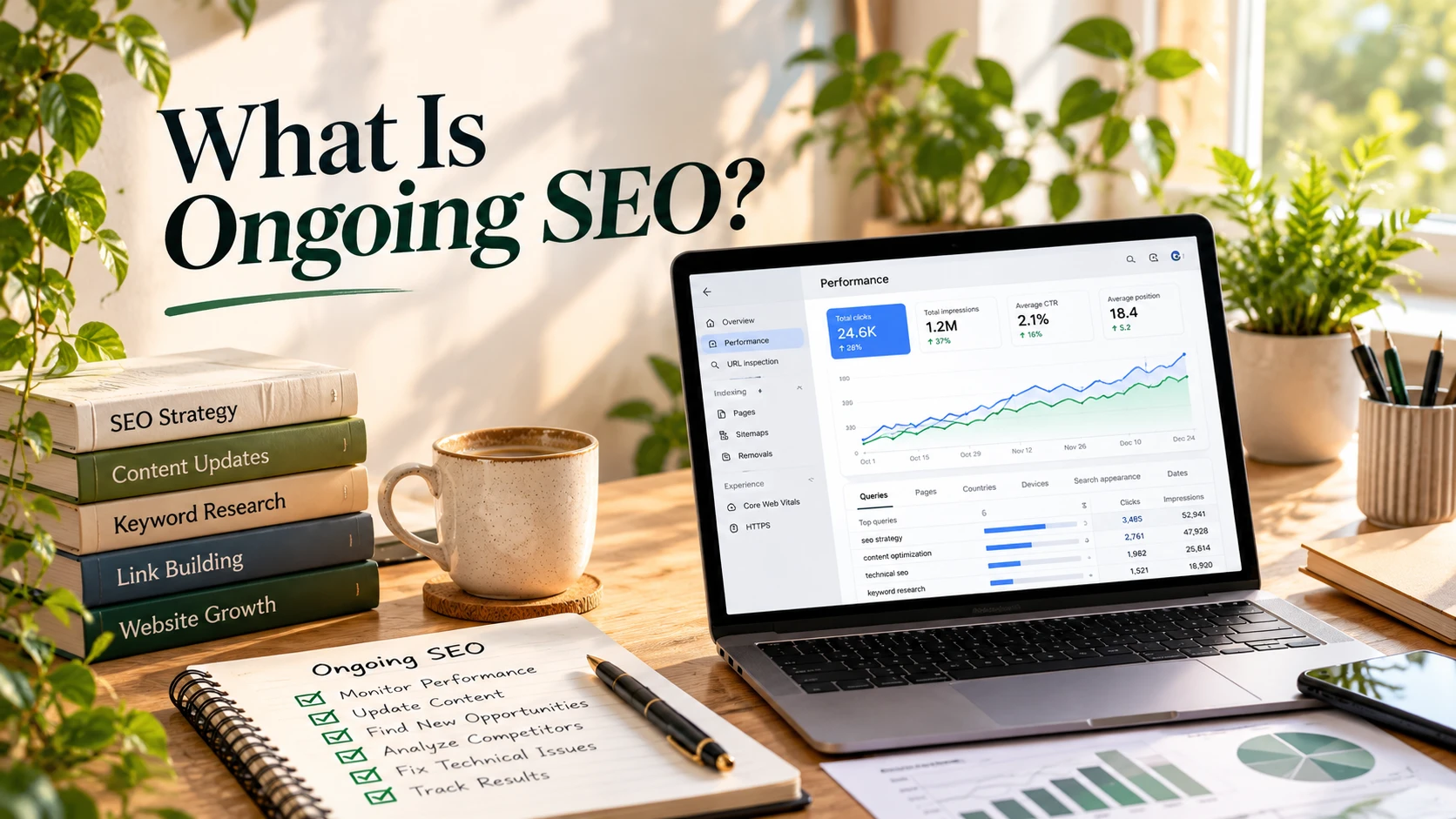
What Is Ongoing SEO?
Ongoing SEO is the continuing work of monitoring, maintaining, and improving a website’s organic search performance after the initial optimization is done. It covers technical checks, content updates, keyword research, internal linking, competitor analysis, and performance reporting, all guided by data rather than a fixed checklist.
SEO is generally not a one-time project. Competitors publish new pages, search results change, content ages, and sites pick up technical problems as they grow. Ongoing SEO is how a business keeps up with those changes and finds new opportunities.
The amount of work varies a great deal. A small local site in a quiet niche may need a light monthly review. A large ecommerce store in a competitive market may need continuous attention from a team. Industry, competition, site size, goals, and existing authority all shape the workload. It does not mean daily tasks or permanent outsourcing.
Many sites handle much of it in-house, and the work is about acting on meaningful opportunities, not performing arbitrary tasks forever.
Ongoing SEO Explained: The Essential Basics
In practice, ongoing SEO is the recurring work that keeps a site healthy and competitive in organic search. You may also see it called SEO maintenance, continuous SEO, ongoing search engine optimization, or SEO management. Agencies that sell it as a package usually call it ongoing SEO services.
The main areas involved are:
- Technical SEO monitoring
- On-page SEO and content optimization
- Content creation and content refreshes
- Keyword research and search intent analysis
- Internal linking
- Competitor analysis
- Authority and link-related work
- Performance monitoring in Google Search Console and analytics
- Troubleshooting when something drops or breaks
Why Is SEO an Ongoing Process?
SEO is an ongoing process because the conditions behind organic search performance keep shifting. A page that performs well today is competing in a moving environment.
The practical reasons:
Competitors keep working.
Other sites publish new pages, improve old ones, and earn attention. A position you hold is not permanent.
Search results and intent change.
Layouts, features, and the mix of result types can shift, and the same query may start favoring guides over product pages. That can affect clicks even when your ranking holds.
Demand and behavior shift.
Seasonality, trends, and the devices people use all influence what gets searched.
Content ages.
Statistics, prices, product details, regulations, and processes go out of date.
Technical issues appear.
Developers release updates, plugins change, URLs get redirected, and pages get blocked or removed by accident.
New opportunities emerge.
Fresh queries show up in your data, new products launch, and customers start asking different questions.
Internal linking drifts.
As a site grows, important pages can end up with few links pointing to them.
Search systems evolve.
Google updates its systems and guidance over time. Most changes do not demand immediate action, and a site built around helpful content and sound technical practice rarely needs to react to every announcement.
Ongoing SEO vs. One-Time SEO
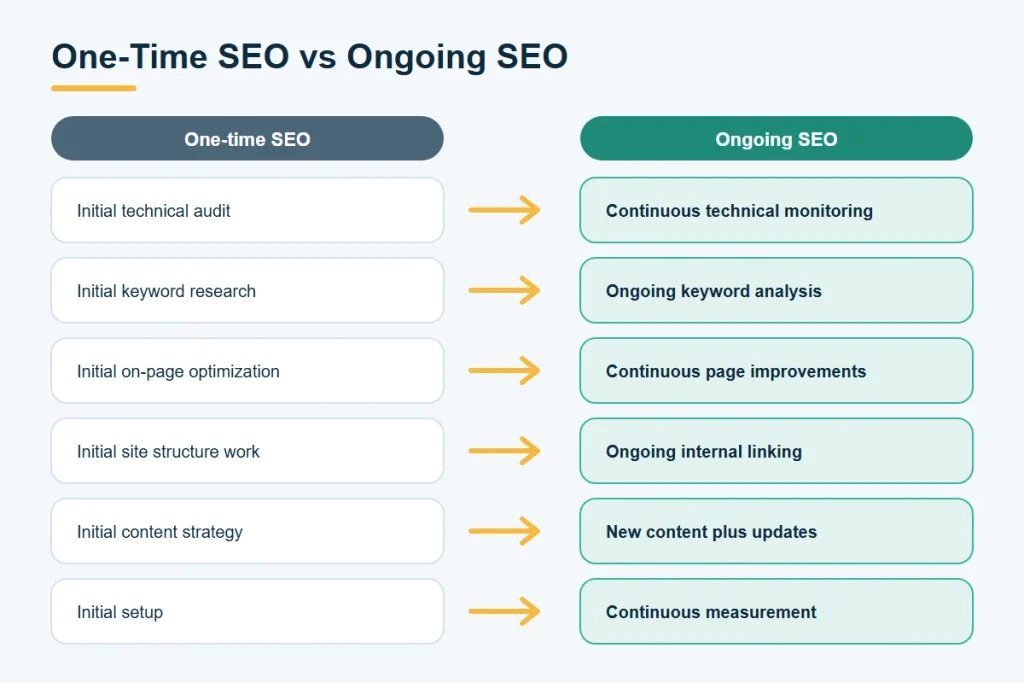
One-time SEO work builds a foundation. Ongoing SEO maintains and extends it. The two are not rivals, and most sites benefit from both.
| One-Time SEO | Ongoing SEO |
| Initial technical audit | Continuous technical monitoring |
| Initial keyword research | Ongoing keyword and query analysis |
| Initial on-page optimization | Continuous page improvements |
| Initial site structure work | Ongoing internal linking and architecture improvements |
| Initial content strategy | New content plus content updates |
| Initial setup | Continuous measurement and adjustment |
A one-time project is a reasonable choice when a site needs a specific fix, such as a migration, a technical cleanup, or a restructure. The risk is assuming the job is finished afterward. Without follow-up, nobody checks whether the fixes worked, whether new issues appeared, or whether the strategy still fits.
What Does Ongoing SEO Include?
This section covers the main recurring activities. You do not need to do all of them at the same intensity. Choose based on your site and goals.
Keyword and Search Performance Monitoring
Monitoring shows what is happening in search before you decide what to change. The core data usually comes from Google Search Console, which reports clicks, impressions, click-through rate, and average position for queries and pages.
Useful things to track:
- Search queries: the terms that already bring people to your site, including ones you never targeted.
- Impressions and clicks: impressions show visibility, clicks show whether people choose your result.
- Click-through rate: a page with high impressions and unusually low CTR may be worth reviewing for title relevance, search intent, position, and SERP features. Low CTR does not automatically mean the title is wrong.
- Landing pages: which pages attract organic visits and what those visitors do next.
- Keyword rankings: useful for tracking priority terms, as long as you understand their limits.
- Search visibility: some third-party tools estimate overall visibility across a keyword set. Treat this as a directional estimate rather than an exact measure.
- Changes in search intent: shifts in the type of pages that rank for a query.
Content Updates and Refreshes
Existing content often holds the best opportunities, because those pages already have some visibility and history.
Signs that a page may need an update:
- Outdated statistics or dated references
- Old product, pricing, or service information
- Processes or regulations that have changed
- Broken links or references to sources that no longer exist
- Missing information that searchers clearly want
- Better competing pages appearing in the results
- A shift in search intent
Updating does not mean changing content for the sake of it. Altering a date or rewording a few sentences adds little. A useful refresh corrects what is wrong, fills real gaps, improves clarity, and keeps the page aligned with what searchers need. If a page is performing well and still accurate, leave it alone.
Publishing New Content
Ongoing keyword research helps you find topics your site does not cover yet. Search Console queries, customer questions, sales conversations, and competitor coverage all point to possible new pages.
Publish when there is a real gap and you can serve it well. There is no number of articles per month that guarantees growth, and publishing more does not automatically improve rankings. A smaller number of relevant, useful pages can be more valuable than a steady stream of thin ones.
On-Page SEO
On-page SEO is the ongoing review of how individual pages are built and how well they match what searchers want. Typical checks include:
- Page titles and meta descriptions
- Headings and content structure
- Whether the page matches search intent
- Internal links to and from the page
- Image optimization, including file size and alt text
- Whether the content is complete and accurate
Base changes on evidence. If a page already performs well, repeatedly rewriting its title can create noise and make results hard to interpret. Look for pages with a clear signal, such as strong impressions with unusually low CTR, and investigate the cause before changing anything. Position and SERP features can explain low CTR as much as the title does.
Technical SEO Monitoring
Technical SEO monitoring catches problems that can affect how search engines crawl, index, and understand your pages, or how people use them. Key areas:
- Crawlability: whether search engines can reach important pages, including robots.txt rules.
- Indexing: whether the right pages are indexed. The Page indexing report in Search Console shows which pages are indexed and why others are not.
- Broken links and redirects: dead links, redirect chains, and redirects pointing to the wrong place.
- Canonicals: whether canonical tags point to the intended version of a page.
- Noindex directives: accidental noindex tags are a classic cause of pages vanishing from results.
- XML sitemaps: whether they list the pages you want indexed and stay current.
- Duplicate URLs: parameter variations or multiple versions of the same page.
- Mobile experience: whether important pages work properly and are usable on mobile devices.
- Page experience and performance: loading speed, responsiveness, and layout stability. Google’s Core Web Vitals are one way to assess this.
Not every technical issue causes ranking problems. Focus on issues that can affect crawling, indexing, accessibility, usability, or search performance. A harmless warning in a tool report is not an emergency, while a template change that adds noindex to a key section is.
Internal Linking
Internal links connect your pages, help visitors navigate, and help search engines discover pages and understand how they relate. As a site grows, links need regular attention.
Review internal linking to:
- Link relevant pages to each other with descriptive anchor text
- Support your most important pages with links from related content
- Improve navigation paths
- Help search engines find new pages
- Avoid orphaned pages, meaning important pages with no internal links pointing to them
Competitor Analysis
Competitor analysis shows how others approach the same searches. Ongoing monitoring can reveal:
- New topics competitors are covering
- Content gaps on your site
- Changes in who ranks for important queries
- New pages that have appeared
- SERP features such as featured snippets, video results, or local packs
- Different ways of satisfying the same search intent
- Areas where competitors are weak and you could do better
The aim is to learn, not to copy. Reproducing a competitor’s page rarely produces something more useful than theirs. Look for angles, depth, or expertise you can offer that they do not.
Backlinks and Authority
Relevant, editorially earned links can support a site’s ability to compete in organic search, particularly for competitive topics, so ongoing SEO may include monitoring and earning them. This is not a numbers game, and more backlinks do not automatically mean higher rankings. Relevance and quality matter more than volume.
Legitimate approaches include:
- Creating genuinely useful resources and original research
- Digital PR and newsworthy content
- Partnerships and collaborations
- Appropriate outreach to sites where your content adds value
How Often Should SEO Be Done?
There is no single schedule that suits every site. The table below is a practical starting point, not an official standard.
| SEO Activity | Typical Review Frequency |
| Search performance | Weekly or monthly |
| Technical monitoring | Regularly, often monthly |
| Important ranking changes | Weekly or as needed |
| Content updates | Based on content age and performance |
| Keyword research | Monthly or when strategy changes |
| Competitor analysis | Monthly or quarterly |
| Full technical audit | Periodically, depending on site size |
| Internal linking | Whenever new content is published and during audits |
What moves a site toward more frequent work:
- Website size: large sites generate more issues and more opportunities.
- Industry: fast-moving sectors need closer monitoring than stable ones.
- Competition: crowded markets leave less room for neglect.
- Publishing frequency: more new pages mean more linking and indexing checks.
- Website changes: redesigns, migrations, and platform updates call for extra monitoring.
- Current SEO condition: sites with unresolved foundational issues usually need more work initially.
- Business goals: aggressive growth targets require more active management.
What Does an Ongoing SEO Strategy Look Like?
An ongoing SEO strategy works as a cycle. The details differ by site, but a typical workflow looks like this:
- Establish a baseline. Record current clicks, impressions, rankings for key terms, conversions, and known technical issues.
- Identify the highest-value opportunities. Use Search Console, analytics, and keyword research to find where improvement is most likely to matter.
- Fix critical technical problems. Resolve issues that block crawling, indexing, or usability first.
- Improve existing pages. Update content, titles, structure, and links on pages with clear potential.
- Publish useful new content. Fill genuine gaps that serve real search demand.
- Strengthen internal linking. Connect new and existing pages sensibly.
- Monitor search performance. Track the effect of changes over a reasonable period.
- Analyze competitors. Look for shifts in the results and new approaches.
- Update the strategy based on results. Keep what worked, drop what did not.
- Repeat the process.
How to Prioritize Ongoing SEO Work
Not every task is worth the same effort. A simple prioritization approach weighs these factors:
- Potential business impact: will this affect leads, sales, or other goals?
- Search opportunity: is there real demand and room to improve?
- Current ranking position: pages already close to a better position often respond to smaller changes.
- Traffic potential: how many relevant searches could this capture?
- Conversion relevance: does the query attract people likely to act?
- Technical severity: is something blocking pages from being crawled or indexed?
- Effort required: can you achieve a meaningful result with reasonable work?
Here is a practical example. Say a service page ranks around positions 5 to 15 for a commercially relevant query. Improving its content, matching intent more closely, and adding internal links from related pages may deliver more value than writing a new article on an unrelated high-volume keyword. The page already has some visibility, and the query is closer to a business outcome..
How to Measure Ongoing SEO Success
Start by separating activity from results. Publishing ten posts, fixing fifty broken links, or sending outreach emails are activities. Results are changes in how search brings people to your site and what they do there.
Useful measures include:
- Organic clicks: how many people click through from search results.
- Organic impressions: how often your pages appear.
- Relevant keyword rankings: movement on terms that matter to the business.
- Search visibility: an estimate of presence across a keyword set, usually from a third-party tool.
- Organic traffic: visits from search, ideally segmented by landing page.
- Conversions: form submissions, purchases, sign-ups, calls, or other goals.
- Leads or sales: the business outcomes that conversions represent.
- Indexed pages: useful when you are adding content or fixing indexing problems.
- Landing-page performance: engagement and conversion behavior on key pages.
Traffic alone does not prove success. Large volumes of irrelevant traffic can look impressive in a report without producing a single customer. Tie measurement to business-relevant outcomes wherever you can.
Keep comparisons consistent. Rankings and impressions vary by country, location, language, device, and search market, and personalization can change what an individual sees. When you compare periods, use the same settings, the same tracking method, and similar time windows. Search Console is an important source of evidence, but it should be interpreted alongside analytics, rankings, conversions, and other relevant data.
How Long Does Ongoing SEO Take to Show Results?
No honest answer gives a fixed timeframe. Claims such as “SEO always takes three to six months” oversimplify. Results depend on:
- Website history: age, past performance, and any previous problems.
- Competition: how strong the sites already ranking are.
- Industry: some markets move faster than others.
- Technical condition: blocked or poorly indexed pages delay everything.
- Content quality: depth, accuracy, and usefulness.
- Search intent: whether your page type matches what searchers want.
- Authority: how well established the site is.
- Existing rankings: pages already near the top respond differently from pages with no visibility.
- Scope of changes: a title tweak differs from a site restructure.
Some improvements can show up relatively quickly, such as fixing an indexing error or improving a page that already ranks. More competitive growth, such as breaking into a crowded topic, can take considerably longer. Search engines also need time to recrawl and reassess changed pages, so judge results over a sensible window instead of day to day.
What Happens If You Stop Doing SEO?
Stopping SEO does not make rankings disappear overnight. A well-built site can keep performing for a long time. What happens depends on what exactly stops:
- Stopping active optimization: you stop finding and capturing new opportunities, while competitors continue to.
- Stopping content updates: pages gradually become outdated and may lose ground to fresher, more complete results.
- Stopping technical maintenance: small issues accumulate, such as broken links, redirect chains, or accidental indexing changes.
- Stopping measurement entirely: you lose the ability to spot problems early, so a drop may go unnoticed for months.
Over time, the likely outcome is a gradual erosion of position and a growing list of missed chances, not a sudden collapse. The effect is larger in competitive markets and smaller on stable, low-competition sites. If budget is tight, reducing the scope of work is usually wiser than stopping entirely. Keep a basic monitoring routine so you can see problems when they happen.
Ongoing SEO for a New Website vs. an Established Website
The focus of ongoing SEO shifts with a site’s maturity.
| Focus Area | New Website | Established Website |
| Foundation | Technical setup, site architecture, indexation | Technical maintenance and cleanup |
| Content | Initial content covering core topics | Content refreshes and consolidation |
| Research | Keyword research and search intent mapping | Existing ranking opportunities and competitor gaps |
| Structure | Internal linking and topical relevance | Internal linking improvements and cannibalization checks |
| Performance | Getting key pages discovered and indexed | Declining pages, conversion improvements, protecting current visibility |
A new site needs a sound technical foundation, a logical structure, and enough relevant content to establish what it is about. Early work is about getting pages crawled, indexed, and connected.
An established site usually has more data and more existing assets. The best gains often come from pages that already rank, pages that have declined, and overlapping pages competing for the same query, which is known as cannibalization. Conversion-focused improvements matter more here too, because the traffic is already arriving and the goal is to make it count.
Common Ongoing SEO Mistakes
Publishing content just for volume.
Thin or redundant pages dilute a site and use time that could improve stronger pages.
Changing titles repeatedly without evidence.
Constant edits make it impossible to know what worked and can disrupt pages that were doing fine.
Chasing every keyword trend.
Trends fade, and content built around them may not fit your audience or goals.
Ignoring existing pages.
Old pages with potential go unimproved while effort goes only to new content.
Focusing only on rankings.
Rankings without clicks or conversions say little about business value.
Ignoring conversions.
Traffic that never leads to action is a vanity metric.
Building low-quality backlinks.
Spammy links offer little benefit and can create risk under Google’s spam policies.
Making technical changes without understanding their impact.
A careless redirect, canonical, or robots change can remove pages from search.
Comparing rankings without considering location or personalization.
Different settings produce different results, which leads to false conclusions.
Treating SEO as a fixed checklist.
Sites differ, and a rigid list wastes effort on low-value tasks.
Making changes without measuring results.
Without before and after data, you cannot learn which actions work.
A Practical Ongoing SEO Checklist
Use this as a working routine and adjust the frequency to your site.
- Review Google Search Console performance for clicks, impressions, CTR, and queries.
- Check important ranking changes for priority pages and terms.
- Identify declining pages and investigate possible causes.
- Find pages with ranking opportunities, such as high impressions with unusually low CTR for their position, or positions just outside the top results.
- Update outdated content where it is actually needed.
- Publish genuinely useful new content to fill real gaps.
- Review internal links, especially for new and important pages.
- Check important technical issues, including indexing, redirects, canonicals, and sitemaps.
- Monitor competitors for new pages, topics, and SERP changes.
- Review organic conversions and landing-page performance.
- Document every significant change with the date and reason.
- Measure results before making the next major change.
FAQs
Is SEO an ongoing process?
Generally, yes. Search results, competitors, content, and technical conditions change over time, so most sites benefit from continued monitoring and improvement. The amount of work varies by site.
What is ongoing SEO?
It is the continuous process of monitoring, maintaining, and improving a website’s organic search performance through technical checks, content work, keyword research, internal linking, and measurement.
How often should SEO be done?
It depends on site size, competition, industry, and goals. Many teams review search performance weekly or monthly and run deeper audits periodically. There is no universal schedule.
Does SEO need to be done every month?
Not necessarily in the same amount. Many sites benefit from a monthly review, but the workload can be light for a small, stable site and heavier for a large or competitive one.
Can you stop SEO once you rank?
You can, but results are not guaranteed to hold. Rankings may continue for a while, yet competitors improve, content ages, and technical issues can build up. A reduced maintenance routine is safer than stopping completely.
What is included in monthly SEO?
Typically search performance review, technical monitoring, content updates or new content, keyword and competitor checks, internal linking, and reporting. Exact scope varies by provider and site, and much of it can be done in-house.
How long should a business continue SEO?
For as long as organic search matters to the business. Many companies continue indefinitely, adjusting the level of effort as goals and conditions change.
Is ongoing SEO necessary for a small website?
A small site often needs less, but some monitoring is still useful. Checking Search Console, keeping key pages accurate, and fixing technical problems can be enough, and the site owner can often handle this without outside help.
What is the difference between one-time SEO and ongoing SEO?
One-time SEO covers a defined project such as an audit or initial optimization. Ongoing SEO continues after that, monitoring results, maintaining the site, and acting on new opportunities.