
What Is a Good SEO Visibility Score? A Practical Guide to SEO Visibility
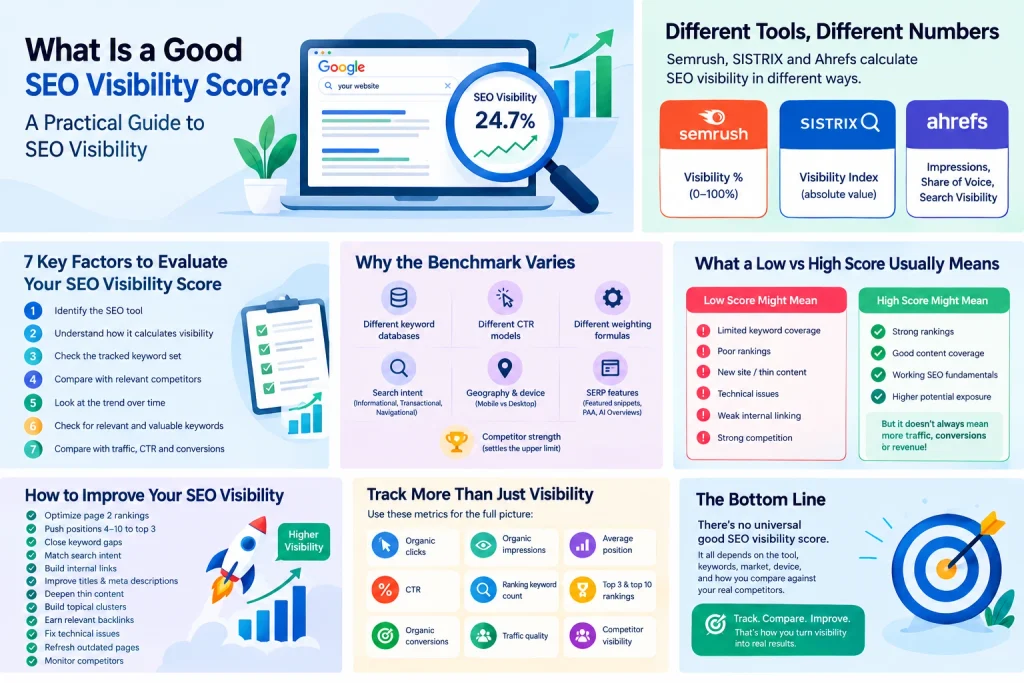
There is no universal good SEO visibility score. What counts as good depends on which tool produced the number, which keywords it’s tracking, which market and device it covers, and how you compare against the sites actually competing with you in search results.
A score of 12% could mean strong performance for a small, focused keyword set in a crowded market, or weak performance for a broad list where you should be doing much better. The number by itself doesn’t tell you which situation you’re in.
What Is an SEO Visibility Score?
An SEO visibility score estimates how much of a website’s potential presence in organic search results it’s actually capturing, across a defined set of keywords. Rank tracking tools calculate it by combining ranking positions with factors such as search volume and expected click-through rate, then expressing the result as a single number.
Visibility is not organic traffic. Traffic counts actual visits; visibility estimates potential exposure whether or not anyone clicks through. It’s also not average position, which only tells you where you rank on average and ignores how much search demand those keywords carry.
A site could hold a strong average position on a handful of low-volume terms and still show weak visibility, because visibility weights rankings by demand rather than treating every keyword equally.
It differs from impressions too. Google Search Console impressions count how many times a page actually appeared for real queries people typed. Visibility scores are usually modeled against a tool’s own keyword set instead, which is one reason the two numbers rarely match.
And visibility isn’t conversions: a keyword can drive strong visibility and still convert poorly if the searcher’s intent doesn’t match what the page offers.
What Is a Good SEO Visibility Score?
A visibility score can’t be judged on its own. The same number means something different depending on the tool, the keyword set behind it, and who you’re being compared against, so the useful question isn’t “is 20% good” but “what do I need to know before I can answer that.”
Here’s a practical framework for evaluating your own score:
Identify the SEO tool.
- A Semrush percentage, a SISTRIX index value, and an Ahrefs Share of Voice figure aren’t built the same way and shouldn’t be read the same way.
Understand how that tool calculates visibility.
- Know whether it’s weighting by click-through rate, search volume, or both, and whether it’s capped at 100% or open-ended.
Check the tracked keyword set.
- A campaign built around 50 branded terms will show a very different score than one tracking 2,000 competitive, non-branded keywords, even for the same website.
Compare against relevant competitors,
- measured in the same tool with the same keyword set. Your score only becomes informative once you know what the sites you’re actually competing against are scoring.
Look at the trend over time.
- A steady climb from 8% to 14% over six months can be more informative about progress than a flat 30% that hasn’t moved.
Check whether the rankings behind the score are for valuable, relevant keywords,
- or whether the number is inflated by terms that don’t connect to what your business actually sells or offers.
Compare the visibility trend against organic traffic, CTR, and conversions.
- If visibility is climbing but none of those move, the keyword set likely doesn’t reflect real buyer or user intent.
Why the Benchmark Varies
The lack of a fixed benchmark comes down to real differences in how the metric gets built, not just inconsistency between vendors.
Each SEO tool maintains its own keyword database, its own click-through-rate model, and its own weighting formula, so two tools measuring the same domain on the same day can legitimately produce different numbers.
A website ranking for 100 low-volume, long-tail keywords will also show a different visibility profile than one ranking for 100 high-volume commercial keywords, even though both might report “100 ranking keywords” in a summary report.
Search intent adds another layer to this: informational, transactional, and navigational queries all draw different click behavior, and a tool’s CTR model has to account for that when it weights a position.
Geography and device compound the effect. Visibility indexes are calculated per market, so a domain can be strong in its home country and close to invisible somewhere it hasn’t built local content or proper hreflang setup. Mobile and desktop SERPs frequently differ in layout too, which changes expected click-through rate at a given position.
SERP layout itself has become a moving target. Featured snippets, People Also Ask boxes, shopping carousels, and AI-generated overviews all compete for the same screen space that organic listings used to have to themselves, and a visibility score based purely on blue-link position won’t capture whether these features are pushing your listing further down the page.
Finally, competitor strength sets a practical ceiling: in a market with a few dominant, well-established players, even a well-optimized site may only reach a certain visibility level without a much larger investment in content and authority.
How SEO Visibility Scores Are Calculated
Even though tools differ, most visibility calculations rest on a similar set of inputs: ranking position, search volume (which determines how much weight a keyword carries), expected click-through rate at that position, the specific tracked keyword set being measured, whether the ranking is a standard organic listing or affected by other SERP features, and in some models, search intent.
Semrush calculates its Visibility % by weighting each of your target keyword rankings according to their average click-through rate, using Semrush’s own CTR data. A domain with no rankings in the top 100 results for any tracked keyword scores 0%, and one holding first place for every tracked keyword scores 100%. Semrush, Semrush Position Tracking documentation
SISTRIX takes a different approach at the data-collection stage. It gathers organic Google rankings across roughly a million representative keywords per market, then weights each ranking by that keyword’s search volume and its expected click-through rate at the measured position. The result is an absolute value that grows as visibility increases, not a percentage capped at a fixed ceiling. SISTRIX methodology
Ahrefs splits the concept across a few separate metrics rather than one composite score: Impressions, which sum the search volume of every keyword a site ranks in the top 10 for, Share of Voice in Rank Tracker, which shows the percentage of all clicks in the SERP going to a site across its tracked keywords, and Search Visibility, which estimates the percentage of clicks a site earns from its organic rankings relative to total clicks available for those keywords. Ahrefs, Ahrefs help center.
SEO Visibility in Semrush vs. SISTRIX
These two platforms are the ones most often confused with each other, so it’s worth a direct, side-by-side comparison.
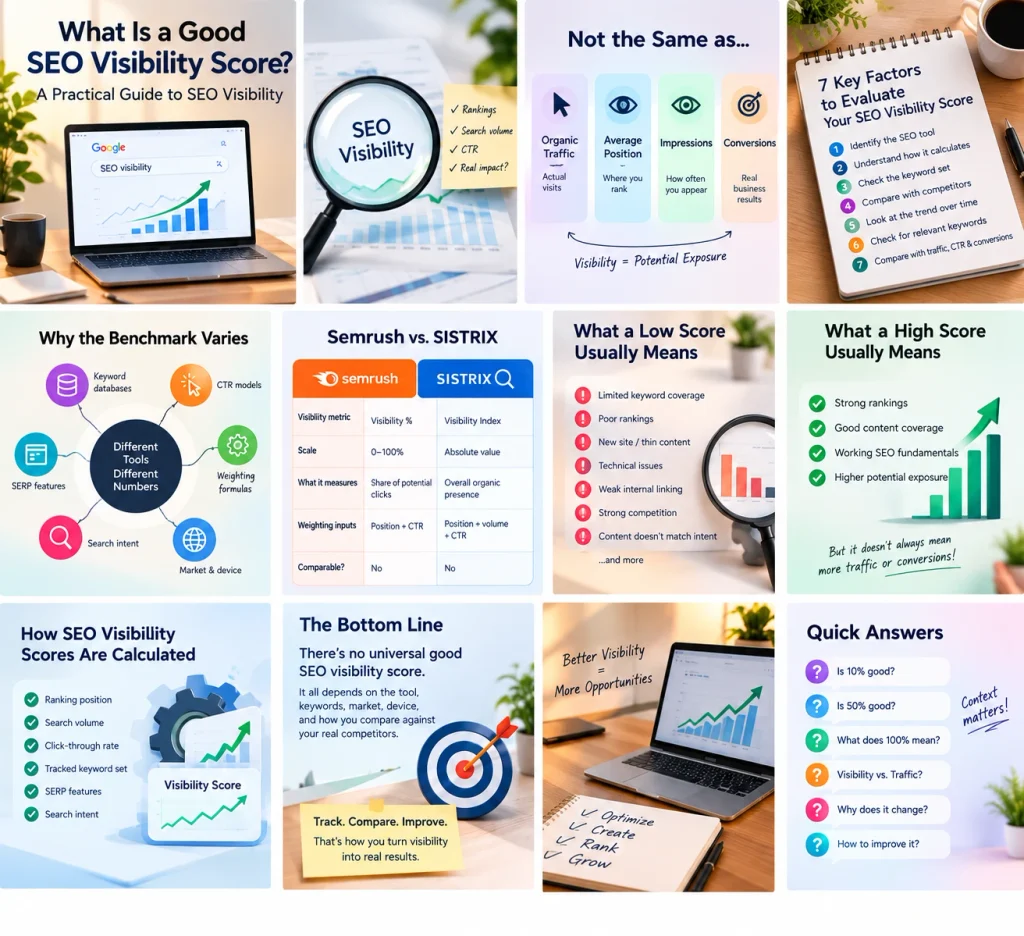
| Aspect | Semrush | SISTRIX |
| Visibility metric | Visibility % | Visibility Index |
| Scale | Percentage, 0 to 100% | Absolute index value, not capped at a fixed ceiling |
| What it measures | Estimated share of potential clicks across a user-defined keyword set | Overall organic presence across a representative keyword sample |
| Weighting inputs | Ranking position and modeled CTR | Ranking position, search volume, and expected CTR |
| Interpretation | 100% means first place for every tracked keyword | No fixed target value; use competitors and trends |
| Directly comparable to the other? | No | No |
The practical takeaway: pick one tool as your primary reference point, track it consistently, and use it to compare against real competitors measured the same way. A Semrush percentage and a SISTRIX index value were never built to sit on the same scale, so don’t treat them as if they do.
What a Low Score Usually Means
A low score can come from several distinct causes, and it’s worth ruling each one out rather than assuming a single explanation:
- Limited keyword coverage, where the site isn’t targeting many of the tracked terms at all.
- Poor rankings on the keywords it does target, sitting on page two or beyond.
- A new site that hasn’t yet built enough content depth or authority to compete.
- Thin topical coverage compared with competitors who’ve built out full topic clusters.
- Technical problems, such as indexing issues or crawl errors, keeping pages out of results entirely.
- A mismatch between page content and search intent for the queries being tracked.
- Strong competition from established, high-authority domains.
- Weak internal linking that starves otherwise decent pages of authority signals.
- Content that doesn’t target the queries being measured, so relevant pages simply aren’t in the running.
If your score is low, the fastest diagnostic is checking whether it’s a coverage problem (you’re not targeting enough relevant keywords), a ranking problem (you’re targeting the right keywords but sitting on page two or beyond), or a technical problem (pages aren’t being indexed or crawled properly at all). Each points to a different fix.
What a High Score Usually Means
A high visibility score generally indicates strong rankings across a meaningful share of the tracked keyword set, and it’s a reasonable signal that a site’s SEO fundamentals, content coverage, and authority are working. It doesn’t guarantee much beyond that, though.
A high score does not automatically mean high-quality traffic, conversions, or revenue, because visibility measures potential exposure, not what happens after someone clicks through.
It also doesn’t guarantee strong rankings for every keyword that matters to the business, since a broad or loosely relevant tracked list can mask weak performance on the specific terms tied to revenue.
A site can post an impressive visibility number built on high-volume but only tangentially related keywords while quietly underperforming on the smaller set of terms its actual customers search for. Keyword relevance decides whether a high score is worth much in practice, so it’s worth checking the keyword list itself before treating the number as a win.
How to Improve Your SEO Visibility Score
Improving visibility comes down to closing specific gaps rather than producing content in general.
- Look closely at pages already ranking on page two. These are often among the quicker opportunities to investigate, since they may need fewer changes to move up than a page starting from nothing, though results still depend on competition, search intent, and the specific query.
- Strengthen pages in positions 4 to 10. Gains in content depth, internal links, or on-page optimization can help push these toward the top three, where click-through rate rises sharply.
- Close relevant keyword gaps identified through competitor comparison, targeting terms your competitors rank for and you don’t.
- Improve search intent alignment, restructuring pages that rank but don’t match what searchers actually want when they land there.
- Build stronger internal links from high-authority pages toward the ones you want to improve, using descriptive anchor text.
- Improve title tags and meta descriptions on underperforming pages to lift click-through rate at existing positions, since some tools factor CTR directly into their weighting.
- Deepen thin content on pages that offer less than what’s currently ranking above them.
- Build out topical coverage through related subtopics and internal clusters rather than isolated pages.
- Earn relevant backlinks from sites genuinely connected to your subject matter, rather than pursuing volume for its own sake.
- Fix technical SEO issues, such as indexing problems or crawl budget waste, that keep pages from ranking at all.
- Refresh pages that have lost rankings, since decline is often about outdated information or weakened internal linking rather than needing a full rewrite.
- Monitor competitors regularly to catch market shifts before they show up as a drop in your own visibility trend.
Metrics to Check Alongside Visibility
Visibility works best as one input in a broader picture, not a standalone scorecard.
- Organic clicks: shows whether visibility is translating into actual visits.
- Organic impressions: reflects real search appearances, separate from a tool’s modeled keyword set.
- Average position: adds detail on where rankings sit, keyword by keyword.
- Click-through rate: shows how compelling your listings are relative to their position.
- Ranking keyword count: tracks the breadth of terms you’re competing for over time.
- Top 3 and top 10 rankings: measure page-one competitiveness directly.
- Organic conversions: connects visibility to actual business outcomes.
- Relevant traffic quality: confirms whether visitors match your actual target audience.
- Competitor visibility: provides the comparison point that makes your own score meaningful.
How Often Should You Track SEO Visibility?
For most established sites, checking visibility weekly and reviewing the trend monthly is a reasonable rhythm. Smaller or newer sites with fewer tracked keywords tend to see more day-to-day volatility, since a handful of ranking changes can swing the score noticeably, so weekly or biweekly review is usually more useful than daily monitoring.
Larger sites with broad keyword sets show smoother, more gradual movement, which makes monthly or quarterly trend analysis a better gauge of real progress than reacting to daily fluctuations. In either case, the trend line matters more than any single day’s number: short-term noise from algorithm updates, SERP feature changes, or seasonal search behavior can shift a score temporarily without reflecting a lasting change in performance.
Frequently Asked Questions About SEO Visibility
What is a good SEO visibility score?
There isn’t one fixed number. A score only becomes meaningful once you know the tool, the tracked keyword set, and how it compares against your actual competitors measured the same way.
Is 10% SEO visibility good?
It depends on the keyword set and market. For a broad, competitive list, 10% might represent solid mid-tier performance. For a small, targeted list where you should be dominant, it could signal a real gap.
Is 50% SEO visibility good?
There’s no fixed threshold at which 50% becomes a good score. Whether it represents strong performance depends on the tool producing it, the tracked keyword set, the market, the competitors you’re measured against, the distribution of your rankings across that set, and the platform’s own methodology. In a percentage-based tool, 50% means you’re capturing roughly half the potential visibility across the keywords being tracked, which can be a strong result for a competitive, high-volume keyword set, or an unremarkable one for a small, low-competition list where you’d expect to be near the top. Treat 50% as an example figure to interpret in context, not as an industry benchmark.
What does 100% SEO visibility mean?
In tools like Semrush, 100% means ranking first for every keyword in the tracked set. It’s rare in practice and typically only realistic for small, specific, low-competition keyword lists.
How is SEO visibility different from organic traffic?
Visibility estimates potential exposure across tracked keywords. Organic traffic counts actual visits. A site can have strong visibility and modest traffic if the tracked keywords don’t match high-intent search behavior, or the reverse.
Why does my SEO visibility score change?
Scores shift with ranking movement, algorithm updates, changes to a tool’s keyword database, seasonal search volume, and shifts in SERP layout such as new AI-generated overviews displacing organic listings.
Can SEO visibility increase without more traffic?
Yes. Visibility can rise because of ranking gains on low-intent or loosely relevant keywords, or because a keyword’s search volume increased without a matching rise in clicks to your specific result.
How can I improve my SEO visibility score?
Focus on pages already ranking near page one, close relevant content gaps against competitors, improve search intent alignment, strengthen internal linking, and fix technical issues holding pages back from ranking at all.