How to Market Yourself on Social Media
Most people who try to market themselves on social media start with a platform and a posting schedule. That’s backward. The people who actually build an audience start with a position: a clear, specific answer to who they help, with what, and how. Everything else, the platform, the content format, the posting frequency, is a decision you make after that’s settled, not before.
This guide walks through the practical mechanics of building a personal presence that gets you noticed by the right people, not just more people. It’s written for professionals, freelancers, consultants, and small business owners marketing themselves directly, not a brand account with a marketing team behind it.
Start With a Position, Not a Bio
A bio describes you. A position tells someone why they should care. The difference matters more than it sounds like it should, because most people scrolling past your profile decide whether to follow in under three seconds, and a well-written bio doesn’t win that decision the way a clear position does.
A useful way to build one: “I help [specific audience] do [specific outcome] through [your method or approach].” Notice what’s missing from that sentence: your job title, your years of experience, your company name. None of those tell a stranger what’s in it for them.
Take two people in the same field. One writes “Freelance copywriter | 8+ years experience | Helping brands grow.” The other writes “I help SaaS founders turn confusing product pages into ones that actually convert.” The second one is instantly clearer about who should follow and why, even though it’s shorter and says nothing about credentials.
Once the position is set, resist the urge to broaden it to appeal to more people. A position that tries to serve everyone reads as generic to everyone. Niching down doesn’t shrink your opportunity, it makes the people who do see it far more likely to act, because they immediately recognize themselves in it.
Pick the Platform Where Your Audience Already Is
Being everywhere isn’t a strategy, it’s a way to produce mediocre content on five platforms instead of strong content on two. Each major platform rewards a different format and serves a different audience mindset, and matching your content to the platform’s native behavior matters more than most people account for.
| Platform | Best For | Native Content Format | What the Algorithm Rewards |
|---|---|---|---|
| Professional services, B2B, career-based positioning | Text posts with a strong hook line, short-form video, document carousels | Comments and dwell time in the first hour after posting | |
| Visually driven work, lifestyle-adjacent expertise | Reels, carousels, Stories | Saves and shares more than likes | |
| TikTok | Fast discovery, younger or broader audiences, teaching in public | Short vertical video, 15 to 60 seconds | Watch-through rate and rewatches |
| YouTube (Shorts and long-form) | Deep expertise, tutorials, building long-term trust | Long-form video paired with Shorts as discovery | Session time and click-through from Shorts to long-form |
| X (Twitter) | Real-time commentary, niche professional communities | Short text threads, quick takes | Replies and quote-posts |
The practical rule: pick one platform where your ideal audience already spends time and where the native format matches what you’re actually good at producing. A consultant who’s a strong writer but camera-shy will get further starting on LinkedIn with text than forcing daily TikToks. Add a second platform only once the first one has a consistent rhythm, not before.
Build Your Content Around Three to Five Pillars
Random posting produces random results. A content pillar is a recurring theme your audience can learn to expect from you, and having three to five of them gives you enough range to stay interesting without losing the thread of what you’re known for.
A useful pillar set usually mixes three types of content: something that teaches, something that shows your actual opinion or point of view, and something that shows the human, behind-the-work side of what you do. Here’s what that looks like for a few different professions:
| Profession | Teaching Pillar | Point-of-View Pillar | Behind-the-Work Pillar |
|---|---|---|---|
| Copywriter | Breaking down a real headline or email that worked | Why most “AI-written” content reads the same and what fixes it | A screen recording of an actual editing pass |
| Financial advisor | Explaining one financial concept simply, no jargon | A take on a common but bad piece of financial advice | A walkthrough of how a real (anonymized) client decision got made |
| Web developer | A short before-and-after of a page’s load speed | Why a popular framework or tool is overrated for most use cases | A time-lapse of building a feature from scratch |
The teaching pillar builds trust and gets saved or shared. The point-of-view pillar is what actually gets you remembered, because opinions are what separate a person from a faceless information feed. The behind-the-work pillar builds the parasocial familiarity that turns a follower into someone who reaches out when they need what you offer.
Why Video Carries the Algorithm Right Now
Across nearly every major platform, short-form video is currently getting the widest organic reach relative to follower count, and that’s not a temporary quirk, it reflects where these platforms are actively investing their recommendation systems. Reels, Shorts, and TikTok all prioritize getting content in front of people who don’t already follow you, which static posts and carousels generally don’t do as aggressively.
This doesn’t mean every post needs to be video. It means video is currently the format most likely to get you discovered by people outside your existing audience, while other formats like carousels and text posts tend to perform better for depth and for engaging people who already follow you. A practical split for someone building a presence from scratch: lead discovery efforts with short video, and use other formats to deepen the relationship once someone’s already found you.
The mechanics of a video that performs well are fairly consistent regardless of platform. The first one to three seconds decide whether someone keeps watching, so the opening needs to state the problem or the surprising claim immediately, not build up to it. Faces on camera consistently outperform faceless or purely text-on-screen content, because viewers connect with a person before they connect with information. And captions aren’t optional. A large share of video is watched with the sound off, and content without captions loses a meaningful chunk of its potential audience in the first second.
Show Your Actual Opinions, Not Just Your Expertise
There’s a specific failure pattern worth naming directly: posting only safe, widely agreeable information. “Five tips for better email subject lines” gets scrolled past because it could have been written by anyone, including an AI tool, in about ten seconds. What gets remembered is a specific, sometimes uncomfortable point of view: why a popular piece of advice in your field is actually wrong, what you’d do differently than the standard approach, or what you’re willing to say that most people in your space avoid saying.
This matters more now than it did a few years ago, not less, precisely because generic informational content has become trivially easy to produce with AI. A reader can get a list of tips from a search engine or a chatbot in seconds.
What they can’t get from those sources is a specific person’s judgment, shaped by actual experience, that they’ve decided to trust. That judgment is the part of a personal brand that can’t be copied or automated, and it’s increasingly the actual product people are following you for.
This doesn’t mean manufacturing controversy for its own sake. It means being willing to actually take a position instead of hedging every statement into something so balanced it says nothing. If every post you write could just as easily have been written by your closest competitor, that’s the signal to get more specific about what you actually believe.
Post Consistently, Not Constantly
Consistency and volume get confused with each other constantly, and it’s worth separating them. Consistency means your audience can predict roughly when and what kind of content to expect from you. Volume just means you’re posting a lot, which isn’t the same thing and doesn’t reliably produce better results.
| Posting Frequency | Realistic For | Trade-off |
|---|---|---|
| Daily | Creators with dedicated content production time or a team | Highest reach potential, but quality often drops without support |
| 3 to 5 times per week | Most professionals marketing themselves alongside client work | Strong balance of consistency and quality, sustainable long-term |
| 1 to 2 times per week | Early-stage or very time-constrained professionals | Slower growth, but still builds recognition if genuinely consistent |
| Sporadic, no set rhythm | Nobody, effectively | Undermines trust in the algorithm and in the audience |
Three to five well-made posts a week consistently outperforms daily low-effort posting for most professionals building a personal brand alongside actual client or business work. The algorithm rewards engagement more than raw frequency, and a rushed, low-value post that gets ignored actually signals to the algorithm that your content isn’t worth showing to more people, which can hurt the reach of posts that come after it.
Turn Comments and DMs Into Actual Relationships
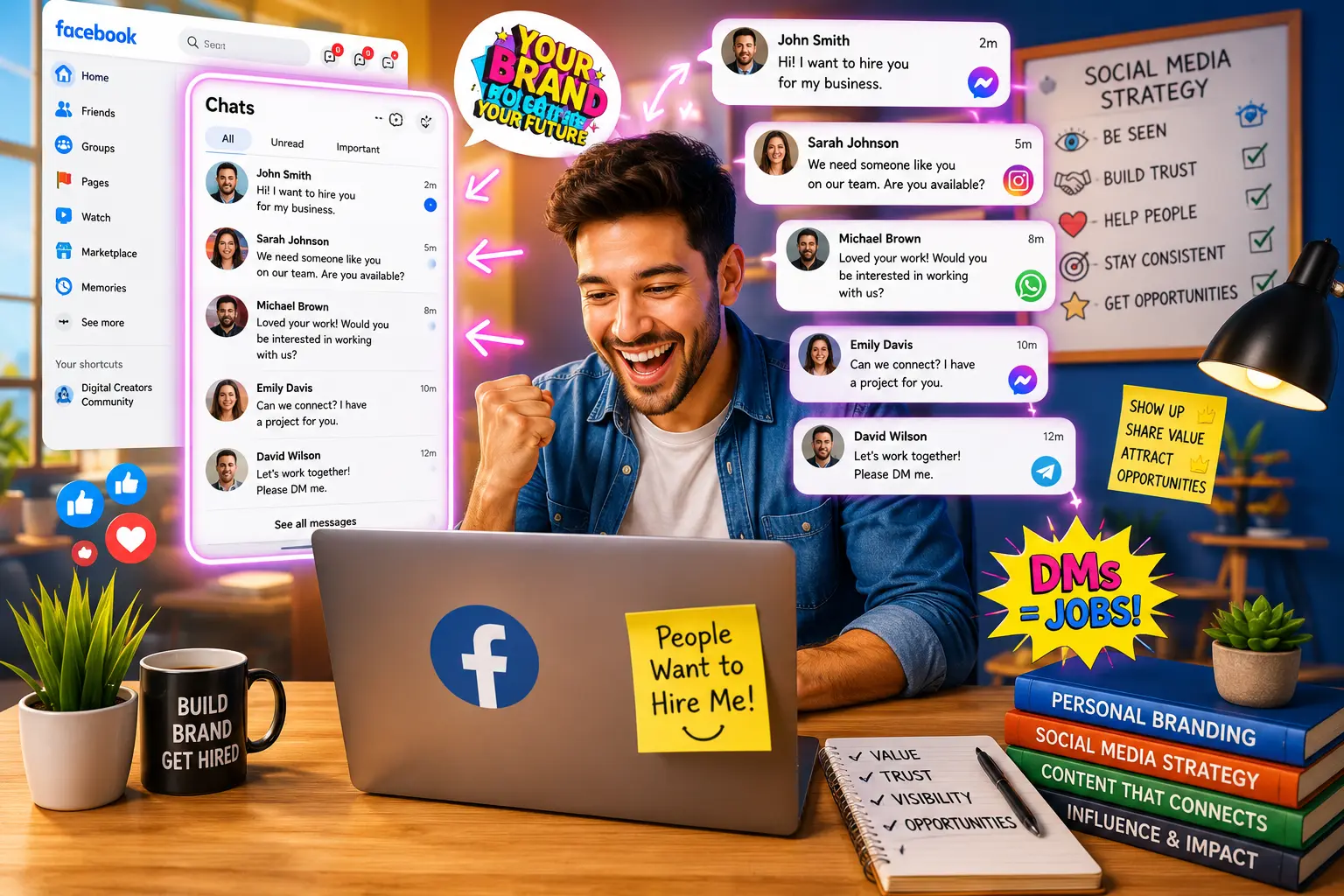
The follower count is the least useful number to obsess over. The businesses and professionals who convert social media into real opportunities are almost always the ones treating comments and direct messages as the actual work, not an afterthought to the posting.
Replying to every comment, especially in the first hour after posting, does two things at once. It signals to the platform’s algorithm that the post is generating a conversation, which tends to widen its reach, and it turns a passive scroller into someone who’s had a direct interaction with you, which is a meaningfully stronger relationship than a like ever creates.
The same logic applies in reverse: commenting thoughtfully on other people’s posts in your space, not with generic “great post!” comments but with an actual added thought, puts you in front of their audience for free. This is one of the most underused tactics in personal branding, largely because it doesn’t feel like “real” content creation, but it consistently produces high-intent followers because the people who see you show up as a genuine expert in someone else’s comments are already primed to trust you before they’ve seen your own profile.
Measure What Actually Predicts Opportunity
Vanity metrics feel good and mean very little on their own. Follower count tells you almost nothing about whether your audience will ever hire you, buy from you, or refer you to someone else.
| Metric | What It Actually Tells You |
|---|---|
| Saves and shares | Content is useful enough that people want to keep or pass it on, a stronger trust signal than likes |
| Profile visits after a post | The content made someone curious enough to check who you are |
| DMs and meaningful comments | Direct interest, the strongest early signal of a potential client or opportunity |
| Follower growth rate relative to reach | Whether your content is converting viewers into an audience, not just getting seen once |
| Website or link clicks | Whether social media is actually driving action outside the platform |
Reviewing these numbers roughly monthly, rather than obsessing over daily fluctuations, gives a clearer read on what’s actually working. A single viral post with high views and low saves usually means broad but shallow reach. A modest post with a high save-to-view ratio usually means it hit exactly the right audience, which matters more for someone marketing themselves professionally than for someone chasing raw visibility.
Repurpose One Idea Across Every Format You Use
Producing entirely original content for every platform is unsustainable for anyone without a content team, and it’s unnecessary. A single solid idea, one client story, one lesson, one strong opinion, can typically become a short video, a text post, a carousel, and a comment-bait discussion question, all from the same core insight.
The practical workflow: write the core idea down in a sentence or two first, before deciding on format. Then adapt the delivery to whichever platform it’s going on, rather than trying to write something platform-specific from scratch every time. This is what allows three to five posts a week to feel sustainable instead of like a constant scramble for new material, and it also reinforces the same message across multiple touchpoints, which is closer to how people actually build familiarity with a person over time.
Common Mistakes That Quietly Kill a Personal Brand
A few patterns show up again and again in accounts that never gain traction despite consistent effort. Posting purely informational content with no point of view makes an account forgettable, since that information is now available instantly from a dozen other sources including AI tools.
Trying to serve too broad an audience with a vague position means nobody feels like the content was made specifically for them. Ignoring comments and DMs wastes the highest-intent signal the platform gives you. And switching strategy every few weeks because results haven’t shown up yet resets the algorithm’s understanding of what your account is about, which slows growth rather than accelerating it.
A Realistic Timeline
Personal branding on social media doesn’t move on the timeline most people expect. Early, visible traction, meaning consistent engagement and a slowly growing follower count that reflects real interest, typically shows up somewhere in the first three to six months of consistent posting. Meaningful business results, meaning inbound inquiries, client interest, or partnership opportunities that trace back to social media, usually take six to twelve months of sustained, consistent effort before becoming reliable.
That timeline is the actual reason most people quit too early: they judge the strategy by month one results instead of month six. The professionals who do see real return from social media are almost always the ones who kept the position, pillars, and posting rhythm steady long enough for an audience to actually form a consistent impression of who they are and what they’re for.
FAQs
How many social media platforms should I actually be on?
One, until it has a consistent rhythm and is producing real engagement, then a second one if you have the capacity to maintain both without dropping quality. Spreading effort across four or five platforms from day one is the most common reason personal branding attempts stall out, since each platform demands a different content format and none of them get done well.
Do I need to show my face on camera to build a personal brand?
It’s not strictly required, but accounts that show a real face on camera consistently outperform faceless or text-only accounts, because viewers connect with a person before they connect with information. If camera work genuinely isn’t an option, lean into a platform and format that rewards writing, like LinkedIn text posts or X threads, rather than forcing video.
How long before social media marketing actually brings in clients or opportunities?
Early engagement and follower growth usually show up within three to six months of consistent posting. Inbound inquiries and business results that clearly trace back to social media typically take six to twelve months of sustained effort. Most people quit before that window closes, which is the main reason the strategy “doesn’t work” for them.
Should I use AI to write my social media content?
AI can help with drafting, editing, or repurposing an idea across formats, but the actual opinions, stories, and judgment need to come from you. Purely AI-generated posts tend to read as generic, and generic content is exactly what gets scrolled past, since a reader can get the same surface-level information from a chatbot directly.
What’s the fastest way to know if my content strategy is working?
Don’t judge it by follower count or likes. Track saves, shares, profile visits after a post, and DMs or meaningful comments over a full month. A rising save-to-view ratio and an increase in direct messages are much stronger signals that the right audience is paying attention than raw view counts or follower growth alone.
The Next Step
Before posting anything new, write down your position in one sentence, using the “I help [audience] do [outcome] through [method]” structure, and pick the single platform where that audience already spends time. Everything else in this guide, the pillars, the format, the posting rhythm, only works once that first sentence is genuinely specific. A vague position is the most common reason a consistent, well-produced content strategy still fails to build an audience that converts into real opportunities.


4 Comments
Comments are closed.