How Can Email Marketing Fuel Your Overall Inbound Strategy? An important Guide
Getting someone to visit your website solves only part of the inbound marketing problem. The harder part is building a relationship with that person once they’re gone, so they come back, trust your business, and eventually take action. Email marketing is one of the few channels built specifically for that job. So how can email marketing fuel your overall inbound strategy?
It gives businesses a direct, permission-based line to people who have already shown interest, letting them nurture that interest with relevant content, guide subscribers toward meaningful next steps, and support customers well after their first visit.
What Is Inbound Marketing?
Inbound marketing is a set of connected activities aimed at attracting and helping people rather than interrupting them. It typically includes useful content published on a blog or resource hub, SEO and organic discovery that help the right audience find that content, social media that extends its reach, lead generation offers that people genuinely want, and customer experiences, including support, that continue after a purchase.
What makes these inbound rather than outbound is how attention gets earned. A business publishes something genuinely useful, a person finds it because they were already searching for an answer, and the relationship develops from there on the person’s own terms. Inbound marketing works as this whole system together. Email marketing is one part of that system, not a stand-in for SEO, content, or social media.
How Does Email Marketing Support an Inbound Strategy?
Content, search, and social are good at catching someone’s attention once. Email is good at keeping it. Organic social media can also help businesses generate leads before email takes over the nurturing process. The moment a visitor opts in, by subscribing to a newsletter, downloading a resource, or requesting more information, email becomes the channel that carries the relationship forward: delivering educational material, nurturing interest over weeks or months, helping prospects understand their options, pointing subscribers toward relevant resources, and supporting people after they convert.
Here’s a short example. Someone finds a blog post about choosing accounting software through a search, downloads a related comparison checklist, and joins the mailing list as part of that exchange. Over the following two weeks, they get a welcome email, a short sequence breaking down common selection mistakes, and eventually an invitation to see a product walkthrough.
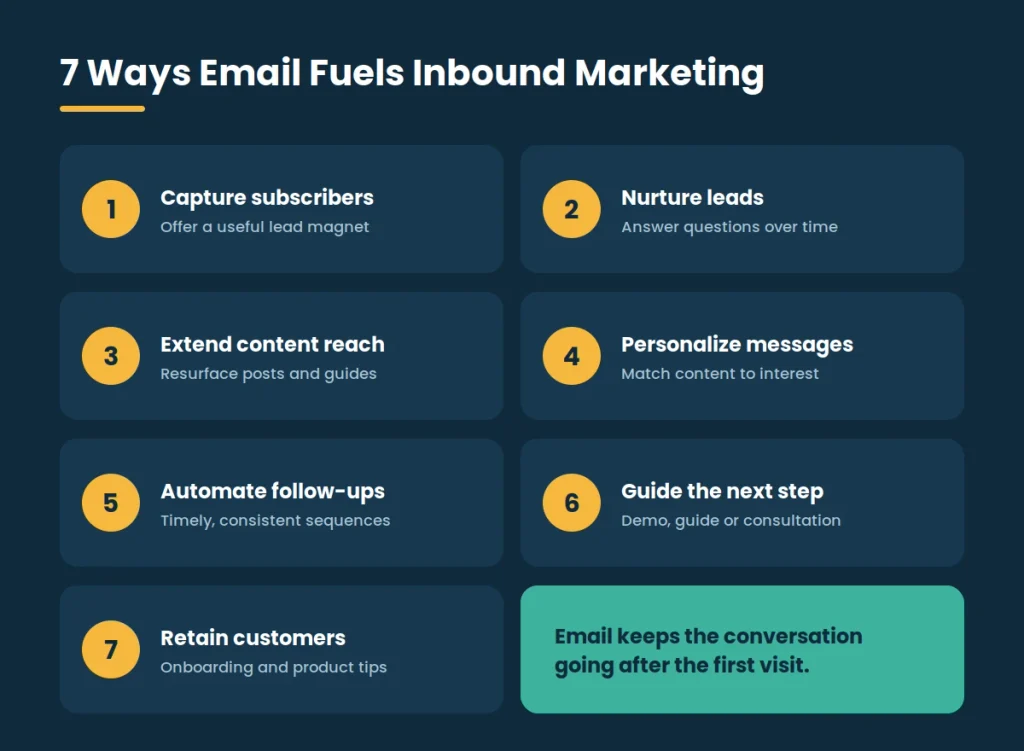
7 Ways Email Marketing Can Fuel Your Overall Inbound Strategy
1. Turn Interested Website Visitors Into Subscribers
Signup forms convert better when they offer something specific instead of a vague promise of updates. A relevant lead magnet, whether that’s a checklist, template, or short guide tied to the content a visitor is already reading, gives people a concrete reason to hand over their email address.
Permission is part of the offer, not an afterthought. Subscribers should know what they’re signing up for and roughly how often they’ll hear from you, which sets the relationship up on clear terms rather than an unexpected flood of unrelated messages later.
2. Nurture Leads With Helpful, Relevant Emails
Most subscribers aren’t ready to buy the moment they join a list. A nurturing sequence gives a business room to answer common questions, work through hesitations, and help a prospect evaluate their options before any sales conversation happens.
A practical version might run like this: the first email delivers the resource someone signed up for, the second addresses a common misconception related to that topic, the third offers a comparison or example, and the fourth introduces a reasonable next step, such as a consultation. Not every subscriber who opens these emails is a qualified lead at that point, which is part of the reason the sequence exists: to help separate genuine interest from passing curiosity over time.
3. Extend the Reach of Existing Content
A blog post, case study, or webinar doesn’t stop being useful after its publish date. Email lets a business resurface that content to an audience that has already opted in, generating renewed engagement without depending on fresh traffic from search or social.
This complements SEO rather than substituting for it. Sending an email to your list doesn’t move Google rankings directly, but the return visits and engagement it produces can support other inbound goals over time, such as repeat traffic and content sharing.
4. Personalize Messages Around Subscriber Needs
What a subscriber has clicked, downloaded, or engaged with previously is useful signal for deciding what to send them next. Someone who’s only read introductory content and someone who’s already requested a demo are at different points in their decision process and benefit from different messages.
As a practical example, a subscriber who downloaded a guide on email segmentation might later receive content about automation, while one who downloaded a budgeting checklist instead receives content related to financial planning tools. This kind of personalization relies on information a subscriber has actively provided or clearly signaled through behavior, not on collecting more personal data than the relationship actually needs.
5. Automate Timely and Relevant Communication
Automation handles the repetitive parts of email, welcome messages, multi-step sequences, and follow-ups triggered by specific actions, without requiring someone to manually send each one. That makes communication more consistent and timely than a fully manual process could manage.
It still needs a person behind it. Automated sequences require periodic review, since an offer that changes, a broken link, or outdated information can sit inside a live sequence for months without anyone noticing unless someone checks. Automation handles delivery; it doesn’t replace judgment about what should be sent.
6. Help Prospects Take the Next Relevant Step
Email can nudge an interested subscriber toward a useful next action: reading a related resource, exploring a product page, comparing options, booking a consultation, or requesting a demo. Which action makes sense depends on where that subscriber actually is, not on what the business is most eager to sell.
A call to action that matches a subscriber’s demonstrated interests can make an email more relevant and may encourage them to take the next step. Results depend on the audience, offer, timing, and overall campaign.
7. Strengthen Customer Relationships and Retention
The inbound relationship doesn’t end at the sale. Onboarding emails, product tips, relevant updates, and support-oriented messages help new customers get real value from their purchase and stay engaged afterward.
This ties back into the broader inbound strategy: a customer who understands how to use what they bought is generally more likely to stay involved with a business, though the exact effect on retention or revenue varies by business and shouldn’t be assumed without data specific to that business.
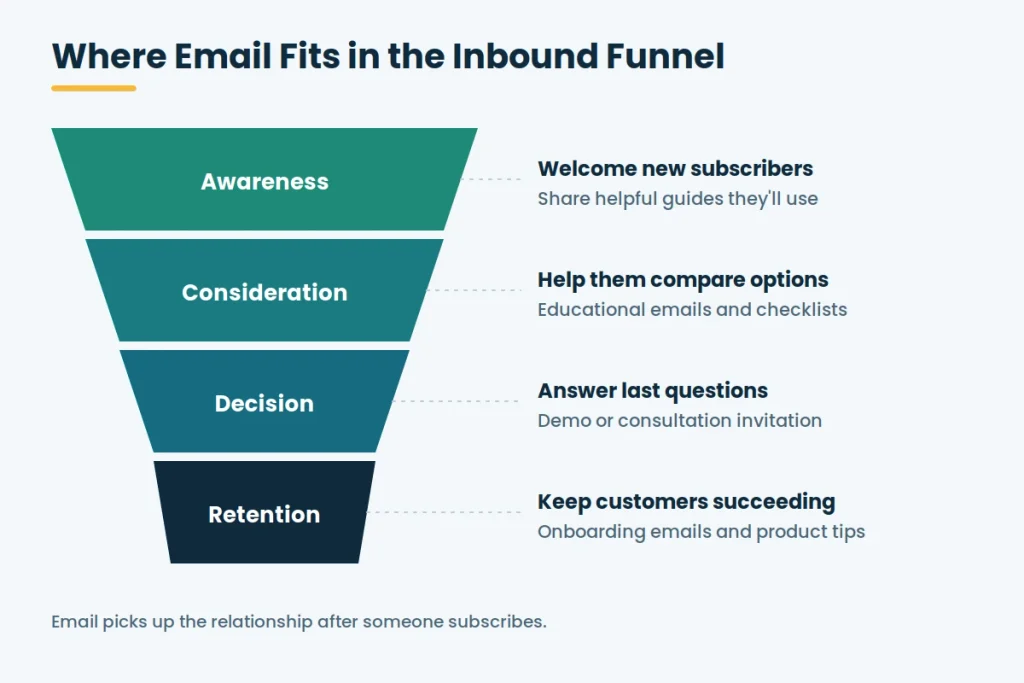
How Email Marketing Fits Into the Inbound Marketing Funnel
| Inbound Stage | Role of Email Marketing | Example |
| Awareness | Introduce useful resources to new subscribers | A welcome email with relevant guides |
| Consideration | Help prospects understand and compare solutions | An educational email or comparison guide |
| Decision | Address remaining questions and explain relevant next steps | A demo invitation or consultation |
| Retention | Help customers continue getting value | Onboarding emails and product tips |
The awareness-stage email in this table generally follows a visitor’s decision to subscribe, rather than creating their initial awareness of the business. That first point of discovery typically comes through content, search, or social media; email picks up the relationship once someone has already opted in.
Customer journeys also rarely move through these stages in a straight line. A subscriber might land directly on decision-stage content if they arrived through a high-intent search, or revisit consideration-stage material after already becoming a customer. The funnel is a useful way to organize a strategy, not a fixed path every subscriber follows in order.
How to Build an Email Strategy Around Your Inbound Content
- Understand the audience and its questions. Start from what your readers are actually trying to figure out, not what you want to promote.
- Identify existing content that addresses those questions. Audit what you already have before creating something new.
- Create a relevant email signup opportunity. Tie the offer directly to the content already attracting the right visitors.
- Set clear expectations when people subscribe. State what they’ll receive and roughly how often.
- Organize subscribers into meaningful segments. Group by interest, behavior, or lifecycle stage rather than treating the list as one audience.
- Develop useful email sequences. Build around a specific topic or goal instead of a loose string of unrelated messages.
- Match calls to action to the subscriber’s needs. Ask for the next reasonable step, not the largest possible commitment.
- Measure results and improve the strategy. Use what subscribers actually do, not just what you hoped they’d do, to refine future sequences.
As an illustrative example, a business might publish a blog post on choosing project management software, offer a related comparison checklist as the signup incentive, and follow up with a welcome email plus a short sequence covering common mistakes, must-have features, and a final invitation to book a walkthrough. This is a hypothetical example meant to show the process, not a documented case study.
Which Email Marketing Metrics Matter for Inbound Success?
Which metrics matter most depends on what a given campaign is trying to accomplish, but a few tend to be worth tracking across most inbound email programs:
Subscriber growth
reflecting whether your content and offers are attracting new interest.
Click-through rate
generally a stronger signal than opens, though not a perfect one.
Relevant website visits from email
connecting email activity back to the content it promotes.
Landing-page conversions
showing whether that traffic takes a meaningful next step.
Lead-to-customer conversion
tying email activity to actual outcomes.
Unsubscribe rate
an early sign when content or frequency isn’t landing well.
Engagement across subscriber segments
showing which groups respond to which content.
Open-rate tracking deserves particular caution. Apple’s Mail Privacy Protection downloads remote content, including tracking pixels, in the background when a message is received rather than when it’s opened, and it does this regardless of whether the recipient engages with the email at all. This registers as an “open” in most tracking systems whether or not the person actually looked at the message, so a recorded open doesn’t reliably mean the email was read.
Email click data can provide useful insight into subscriber engagement, but it should be interpreted carefully. Some email security systems may automatically scan links to check for threats, which can register clicks that do not reflect a recipient’s intentional interaction.
The extent of this activity varies by security system and email environment, so marketers should consider click data alongside conversions and other meaningful actions.
Common Email Marketing Mistakes That Weaken an Inbound Strategy
A handful of recurring mistakes tend to undercut what email could otherwise contribute to an inbound strategy:
- Sending identical messages to every subscriber, regardless of their interests or stage in the journey.
- Offering little value in exchange for a signup, which brings in low-quality leads and drives higher unsubscribe rates later.
- Sending excessive promotional emails, training people to stop opening or to leave the list.
- Ignoring subscriber consent and preferences, which damages trust and can create compliance problems.
- Using irrelevant calls to action, asking for commitments that don’t match where the subscriber actually is.
- Failing to connect emails with appropriate landing pages, so a click leads somewhere that doesn’t match what was promised.
- Neglecting automated campaign maintenance, letting outdated sequences run unchecked for months.
- Measuring success through open rates alone, especially given how unreliable open tracking has become for a meaningful share of most lists.
Making Email Marketing Work With Your Overall Inbound Strategy
Email contributes most when it stays tied to the content, search, and social activity that brought people in to begin with, continuing that relationship rather than running as a separate campaign channel with its own agenda.
Used this way, email does the one job inbound marketing most needs from it: keeping a conversation going with people who have already shown interest, at a pace and depth they’re actually ready for. That ongoing conversation, more than any single tactic, is how email marketing fuels the broader inbound strategy.
Frequently Asked Questions
How does email marketing support inbound marketing?
It continues the relationship after someone discovers a business through content or search, delivering relevant resources and nurturing interest instead of relying on a single visit to convert.
Why is email marketing important for lead nurturing?
It lets businesses deliver information gradually, working through questions and hesitations over several messages rather than expecting an immediate decision.
How can email marketing help convert inbound leads?
By matching content and offers to a subscriber’s actual stage in their decision process, so calls to action feel timely instead of premature.
How does email marketing work with content marketing?
Content and SEO bring in new visitors, and email extends the life of that content by resurfacing it to an engaged, opted-in audience afterward.
What types of emails are useful in an inbound strategy?
Welcome emails, educational nurture sequences, content roundups, onboarding emails, and targeted offers based on subscriber behavior.
How can businesses measure email marketing’s contribution to inbound success?
By tracking website visits from email, landing-page conversions, and lead-to-customer conversion, while treating open and click data as useful but imperfect given tracking and security-scanning limitations.