
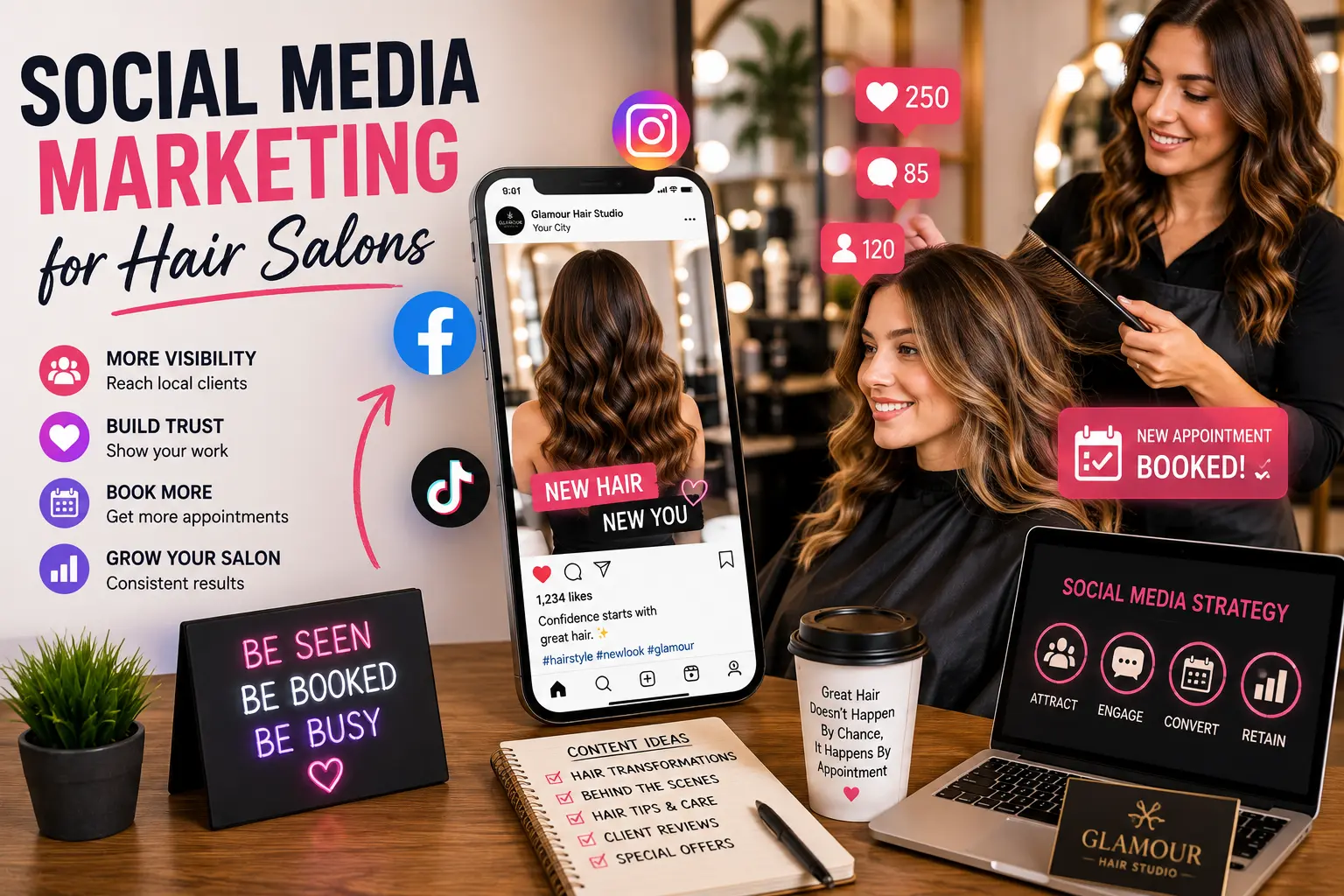
Social Media Marketing for Hair Salons – Tips and Tricks No One Tells
Most people don’t call a salon to ask if it’s any good anymore. They open Instagram, scroll through the last few posts, and decide in about thirty seconds whether this is someone they’d trust with their hair. That scroll is the actual sales pitch now, whether the salon owner treats it that way or not.
This is why two salons with the same skill level can have completely different books. One is fully booked out three weeks, the other has open chairs on a Saturday. The difference usually isn’t talent. It’s that one salon’s feed makes a stranger feel like they already know what they’re walking into, and the other’s feed hasn’t been touched since a slow Tuesday six weeks ago.
Before-and-Afters Still Work, Just Not the Way They Used To
A flat before-and-after photo, side by side, still gets attention, but it’s stopped being enough on its own. What’s actually converting scrollers into bookings now is the reveal moment captured on video: the turn of the chair, the client seeing the color for the first time, the reaction. That few seconds of genuine surprise does more than any caption ever will.
If a stylist is willing to talk through the process for fifteen seconds while working, that’s worth capturing too. A quick explanation of why a certain toner was used, or what makes a particular cut suit a face shape, turns a pretty picture into something that also builds trust in the stylist’s judgment. People aren’t just checking if the salon does good hair. They’re checking if the person holding the scissors knows what they’re doing and can explain it.
The Stylist Should Be the Face, Not Just the Hands
A salon account that only ever shows hair, never faces, misses one of the easiest wins available. Clients don’t just book a service, they book a specific person they feel comfortable with, especially for anything involving color or a big change. A few seconds of a stylist talking to the camera, even just saying what they’re working on today, builds a level of familiarity that a perfectly lit hair photo never will.
This matters even more for newer stylists trying to build their own following inside a salon’s account. Letting each stylist have a visible identity within the salon’s content, rather than posting everything under one anonymous voice, gives clients a reason to ask for someone by name instead of just booking “whoever’s free.”
TikTok and Reels Are Doing the Discovery Work Now
Static photos still have a place for showing off finished work in a polished way, but short video is what’s actually getting salons found by people who don’t follow them yet. Instagram and TikTok both push video further than photos into the feeds of people outside your existing audience, and for a service business trying to reach new locals, that reach matters more than likes on an existing post.
None of this requires a production budget. A phone, decent lighting near a window, and a genuine moment from the workday, someone getting foils done, a finished cut getting styled, a quick before-you-book tip, outperform an overly polished, clearly staged clip almost every time. Salon content tends to work best when it looks like something actually happening in the chair, not like an ad about hair.
Get Clients to Tag You, Then Actually Use It
Every client who leaves happy and posts their own selfie with the new color is producing free, more convincing content than anything the salon could shoot itself. A stranger’s genuine reaction carries more weight than a salon’s own promotional post, because it doesn’t read as an ad.
The habit worth building is simple: ask clients, at checkout or during the appointment, to tag the salon if they post. Then, with permission, reshare those tags to the salon’s own story or feed, and consider keeping a highlight or a saved collection specifically for client-shared photos. It costs nothing and does two things at once: it gives the client a small moment of recognition that makes them more likely to come back, and it fills the feed with proof from real people instead of only the salon’s own voice.
Local Tags Beat Generic Ones
A post tagged with a broad hashtag like #hair or #haircolor is competing against an enormous, mostly irrelevant pool of content. A post tagged with the actual neighborhood or city, paired with a specific service term like a city name plus balayage, or a city name plus curly cut specialist, reaches a much smaller pool of people, but nearly all of them are within driving distance and actually looking for that service. For a business that only serves people who can physically walk in the door, that specificity matters more than reach.
Location tagging on every post and story, not just the profile bio, also helps the account surface when someone browses a location page directly, which is a habit a lot of people already have when they’re new to an area or deciding between a few nearby options.
A Posting Rhythm That Actually Survives a Busy Week
The salons that keep a consistent presence tend to succeed less because they post constantly and more because they picked a rhythm they could actually sustain through a fully booked week. A schedule that only works on slow days falls apart the moment the salon gets busy, which is exactly the wrong time to go quiet.
| Content Type | Suggested Frequency | Best Format |
|---|---|---|
| Transformation or reveal | 2 to 3 times a week | Short video (Reel/TikTok) |
| Stylist-focused clip or intro | Once a week | Short video |
| Client tag reshare | As they come in | Story |
| Educational tip (technique, product, aftercare) | Once a week | Short video or carousel |
| Behind-the-scenes / day-in-the-salon | Once every week or two | Story or casual video |
A batch-shooting habit solves most of the consistency problem. Filming several short clips during one or two appointments and spacing them out across the week means the account doesn’t go dark just because the following week happens to be slammer than usual.
Make Booking a Single Tap, Not a Back-and-Forth in DMs
A lot of salon accounts still rely on “DM us to book,” which quietly loses clients at exactly the moment they’re most interested. Every extra step between seeing a great video and getting an appointment on the calendar is a chance for someone to get distracted and never come back to finish the thought.
A direct booking link, pinned in the bio and, where the platform allows it, attached as a button on the profile itself, removes that friction. If the booking software being used (Vagaro, Booksy, Fresha, Square Appointments, and similar tools all support this) offers a shareable booking link, that link belongs everywhere: bio, story highlights, and even pinned as the first comment on posts that are clearly driving interest.
Reviews and Social Aren’t Separate Jobs
A five-star review sitting on Google isn’t doing much good if nobody sees it before they land on the salon’s Instagram. Pulling strong reviews into a dedicated highlight, or turning a great written review into a short quote graphic, connects two trust signals that are otherwise sitting in separate places. Someone deciding between two similar-looking salons often checks both, and having genuine praise visible in both places closes that gap faster than having it live only where reviews are typically posted.
The same logic runs in reverse. A fully filled-out Google Business Profile, complete with current hours, pricing ranges, and real photos, catches the searches that never make it to Instagram at all, particularly the “near me” style searches from someone who isn’t already following the salon anywhere.
A Referral Push That Doesn’t Cost Much
Referral offers work especially well in a service like this, because a friend’s recommendation already carries more trust than any ad could. A simple structure, something like a discount for both the person referring and the new client they bring in, gives an existing happy client an easy, low-effort reason to mention the salon to someone else.
The mistake most salons make with referral programs is failing to actually promote them anywhere visible. A referral offer that only lives in the owner’s head, or gets mentioned once and never again, doesn’t produce results. Posting it periodically, including it in a story highlight, and mentioning it to clients directly at checkout keeps it in front of the people most likely to act on it.
Where Paid Ads Actually Earn Their Keep
Organic content should come first, since a stranger who clicks into a boosted post only to find three posts from two months ago isn’t going to book. Once there’s a steady rhythm of real content and at least a handful of strong transformation clips, a small local ad budget aimed specifically at a tight radius around the salon tends to perform far better than a broad, citywide campaign.
The highest-performing use of paid spend for most salons isn’t a generic “book with us” ad. It’s boosting a specific, already well-performing organic post, one that’s already proven people respond to it, to a wider local audience who doesn’t follow the account yet. That approach spends money amplifying something already working instead of gambling on brand-new, unproven content.
What Keeps a Salon’s Page Stuck
A few habits show up again and again in salon accounts that post regularly but never seem to turn that effort into new bookings. Posting only finished, heavily edited photos with no video leaves discovery entirely to chance, since photos simply don’t get pushed to new audiences the way short video does. Treating every stylist’s work as interchangeable, with no name or personality attached to individual posts, makes it harder for a specific stylist to build the kind of following that brings in requests by name. And chasing follower count instead of actual local engagement often means the account is technically growing while the appointment book stays exactly the same, because a follower two states away was never going to book a chair.
Getting the First Few Weeks Right
Start with the reveal video habit and the booking link fix. Those two changes alone address the two most common gaps: content that doesn’t get discovered, and interested people who never make it to an actual appointment. Once that rhythm feels normal, layer in the client tagging habit and a proper referral push, since both of those cost almost nothing and compound the more consistently they’re kept up. A salon doesn’t need to be everywhere at once. It needs a feed that makes someone who’s never sat in that chair feel like they already know what to expect when they do.


One Comment
Comments are closed.